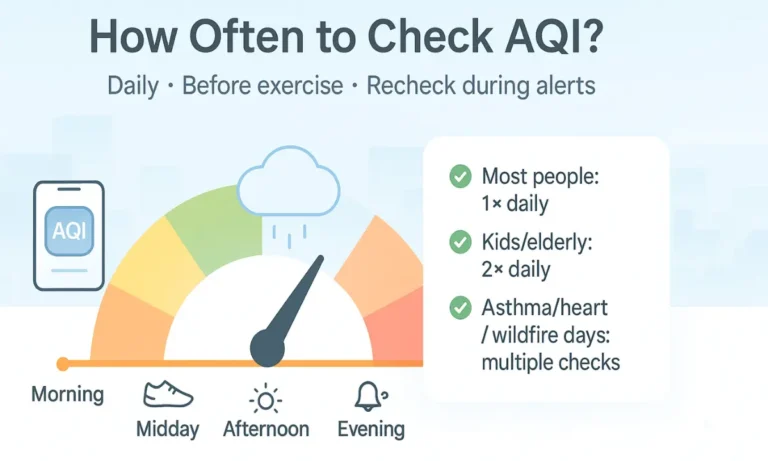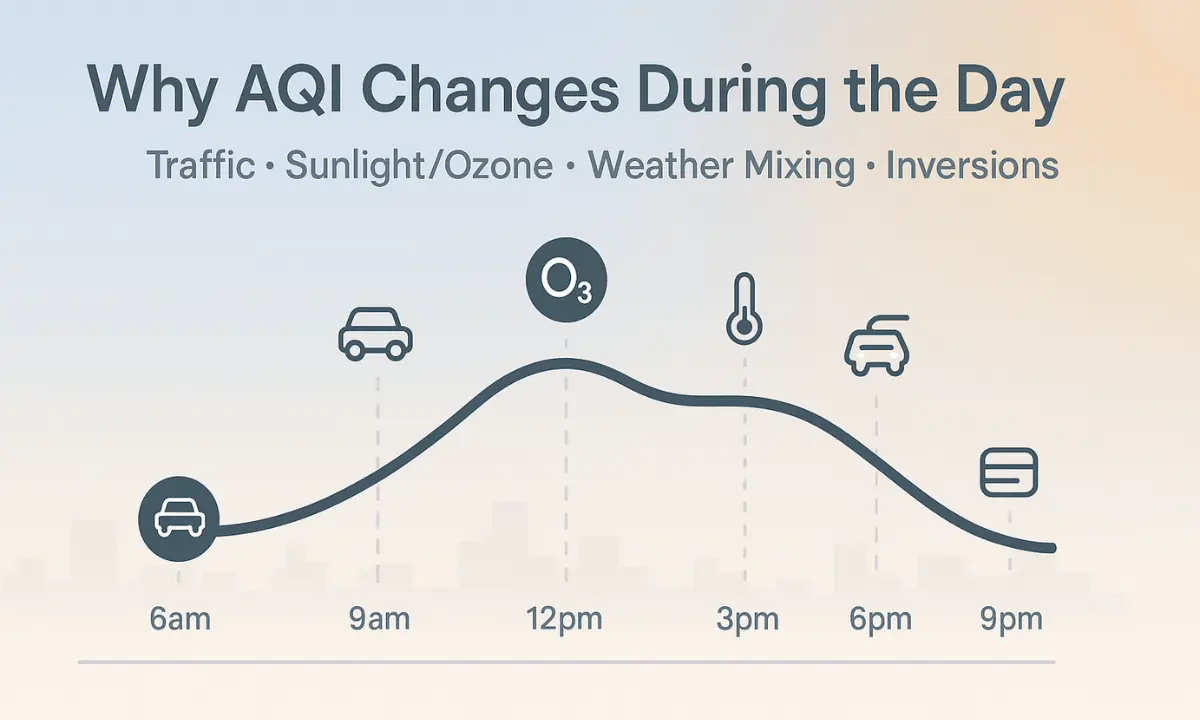
AQI changes throughout the day because pollution levels and weather conditions constantly change.
Traffic, industrial activity, temperature, wind, and sunlight all affect how pollutants build up or disperse at different times.
Many people notice a familiar daily pattern: the air feels fresh and light in the early morning but becomes heavier, hazier, or more irritating by the afternoon. This pattern is not subjective and not random. It reflects how pollution sources, atmospheric physics, and chemical reactions interact over the course of a day.
Air Quality Index (AQI) is a real-time public health signal, not a fixed daily score. It can rise or fall hour by hour, sometimes dramatically. These changes affect when it is safest to exercise, commute, ventilate homes, or allow children to play outside. Understanding the deeper science behind daily AQI variation allows individuals to reduce exposure and make smarter, health-protective decisions.
Understanding daily AQI patterns begins with understanding how AQI itself works and why it is inherently variable.
Understanding the Air Quality Index (AQI)
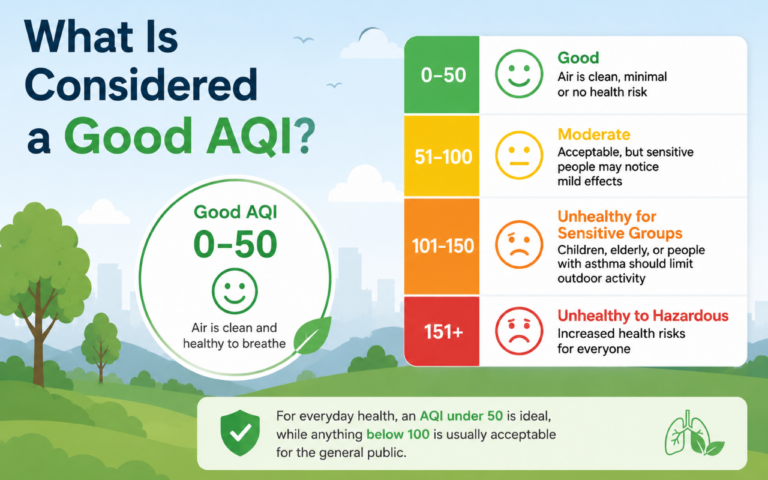
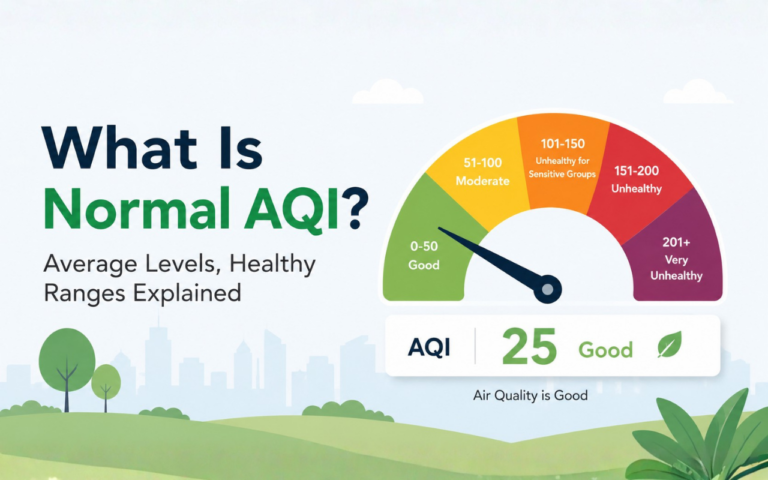
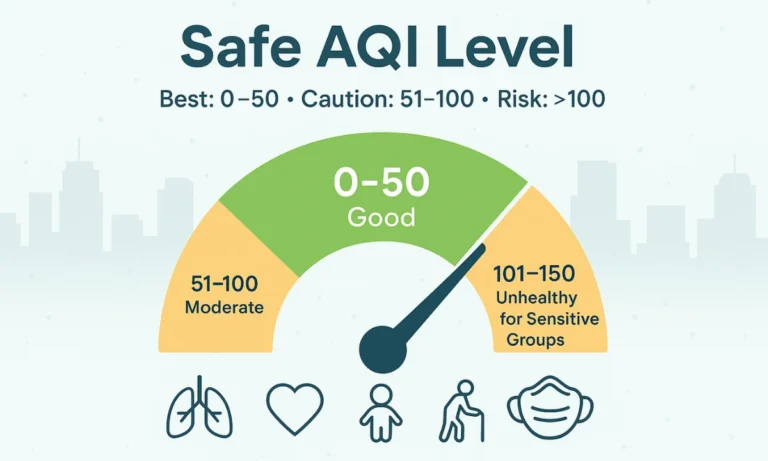
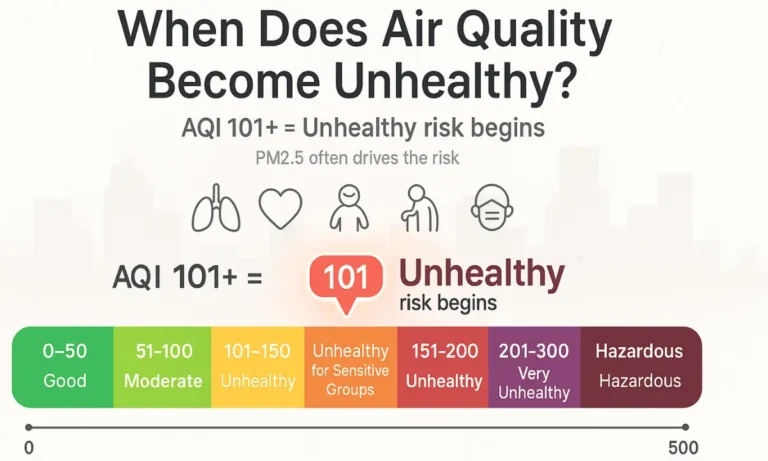
The Air Quality Index is a standardized health-based scale designed to communicate air pollution risk in a simple, actionable form. AQI values range from 0 to 500, where higher numbers indicate greater health concern.
AQI does not represent total pollution. Instead, it reflects the pollutant that poses the greatest immediate health risk at a specific time and location. This design ensures that AQI functions as an early-warning system rather than a technical summary of air chemistry.
How Frequently AQI Is Updated and Why That Matters
Modern air-quality monitoring systems operate continuously. Sensors collect pollutant data, apply short-term averaging, and update AQI values hourly or even more frequently.
Because emissions, weather, and atmospheric chemistry change constantly:
- AQI can rise quickly during traffic surges
- AQI can drop rapidly after wind or rainfall
- AQI can shift even when pollution sources remain unchanged
This constant updating explains why air quality never stays static throughout the day.
Core Drivers Behind Hourly Air Quality Fluctuations
Daily AQI variation results from a combination of emission sources, weather conditions, and chemical reactions. No single factor explains AQI changes on its own. Human activity patterns, solar energy, and atmospheric physics overlap throughout the day. These interacting forces create predictable but dynamic AQI cycles. Understanding these drivers allows better exposure planning.
Morning Rush Hour: Why AQI Rises After Sunrise
In the early morning:
- Large numbers of vehicles emit nitrogen dioxide, carbon monoxide, and fine particulate matter
- The air near the ground is cooler and denser
- Vertical air movement is limited
These conditions trap emissions close to breathing level, often causing AQI to increase shortly after sunrise even before temperatures rise significantly.
Evening Traffic and Cooling Air Effects
In the late afternoon and evening:
- Traffic volume increases again
- Surface air begins to cool
- Atmospheric mixing weakens
Pollutants become concentrated near the ground, leading to another AQI increase. This dual-peak pattern explains much of the daily AQI cycle in cities.
Solar energy fundamentally reshapes air quality as the day progresses.
How Sunlight Drives Ozone Formation
As sunlight intensity increases:
- Chemical reactions accelerate
- Nitrogen oxides and volatile compounds react
- Ground-level ozone forms
Ozone does not appear immediately. It builds gradually, often peaking in mid-afternoon, which is why AQI frequently worsens later in the day even if emissions remain steady.
Why Heat Makes AQI Worse
Higher temperatures:
- Speed up chemical reactions
- Increase the evaporation of pollutants
- Strengthen ozone formation
This is why hot, sunny days almost always produce higher AQI readings than cooler or cloudy days.
Weather determines whether pollution disperses or accumulates.
Wind Speed and Direction
Wind is one of the strongest natural controls on air quality. Strong winds disperse pollutants, lowering AQI. Light or variable winds allow pollution to build up near the ground. Wind direction can also transport pollution from distant sources, such as wildfires or industrial regions. Sudden wind shifts can cause rapid AQI changes.
Vertical Mixing of Air
As the ground warms during the day, air rises and mixes vertically. This mixing spreads pollutants through a larger volume of air, sometimes lowering ground-level AQI temporarily. When vertical mixing weakens later in the day, pollutants concentrate again near the surface. This cycle contributes to daily AQI fluctuations. Vertical mixing is strongly influenced by temperature and sunlight.
Fine particles are one of the most important contributors to short-term AQI variation.
Why PM2.5 Builds Up Overnight
At night, the atmosphere becomes more stable and vertical mixing decreases. A shallow boundary layer forms near the ground, trapping pollutants. Emissions from heating, cooking, and industry accumulate even if overall activity is lower. As a result, PM2.5 concentrations often increase overnight. This explains why early-morning AQI can already be elevated.
Even with reduced activity, pollution accumulates near the surface, which explains elevated early-morning AQI readings.
How Daytime Mixing Changes Particle Levels
During the day:
- Solar heating increases vertical air movement
- Pollutants disperse upward
- Ground-level AQI may temporarily improve
However, new emissions and ozone formation can quickly reverse this effect.
Human behavior follows daily routines that strongly influence air quality.
Morning Pollution Sources
Morning AQI rises are driven by commuter traffic, industrial startups, and residential cooking. These sources release both particles and gases. Combined with limited early-morning mixing, pollution accumulates quickly. This period often marks the first AQI increase of the day. Urban areas are especially affected.
These sources often cause AQI to rise shortly after sunrise.
Midday and Afternoon Pollution Sources
During midday and afternoon hours, construction activity and road dust increase. Ozone formation peaks under strong sunlight. Industrial operations continue steadily. These factors often produce the highest AQI values of the day. Afternoon AQI peaks are especially common during summer.
This period frequently produces the highest AQI values of the day.
Evening and Nighttime Emission Patterns
In the evening, traffic congestion returns and surface air cools. Dispersion weakens, allowing pollutants to accumulate. Residential heating and cooking add to emissions. AQI may remain elevated well into the night. This pattern explains prolonged exposure even after daytime activity ends.
Temperature Inversions and Pollution Trapping
A temperature inversion occurs when warm air sits above cooler air near the ground. This prevents vertical mixing and traps pollution.
Inversions are:
- Common overnight and early morning
- Strong in valleys and urban basins
- A major cause of sharp AQI increases
Rain, Humidity, and Wind Effects
Rain removes particulate matter from the air through washout. Wind disperses pollutants horizontally and vertically. High humidity can increase particle formation and haze. These weather factors can cause sudden AQI improvement or rapid deterioration. Weather changes often explain abrupt AQI shifts.
These forces can cause sudden AQI improvement or rapid deterioration.
Urban Daily AQI Cycles
Cities typically experience morning and evening traffic-driven AQI peaks. Afternoon ozone formation further worsens air quality. Dense emissions and limited dispersion cause frequent short-term fluctuations. Urban AQI is highly sensitive to human activity patterns. City dwellers benefit most from hourly AQI monitoring.
Rural AQI Behavior
Rural areas often have lower baseline AQI. However, they can experience sudden spikes from agricultural burning, dust storms, or wildfire smoke. Long-range pollution transport also affects rural AQI. Rural AQI may remain stable for days, then worsen rapidly. Monitoring remains important despite generally cleaner air.
Rural AQI may remain low for days, then spike suddenly under certain conditions.
When AQI Is Often Lowest
AQI is often lowest in the early morning after sunrise, before traffic peaks. It also improves after rainfall or during windy conditions. These periods provide safer windows for outdoor activity and ventilation. Identifying these windows reduces exposure. Hourly AQI data helps pinpoint them.
When AQI Is Often Highest
AQI is often highest from mid-afternoon to early evening. Hot, sunny weather and stagnant air worsen conditions. Traffic congestion contributes additional emissions. These periods pose higher health risk. Limiting outdoor activity during these hours is advisable.
Using Hourly AQI Trends
Hourly AQI graphs reveal rising and falling patterns throughout the day. They help identify pollution peaks and safer time windows.
Trend analysis is more informative than single readings. This approach supports better planning. It is especially valuable for sensitive groups.
Interpreting AQI Alerts and Advisories
AQI alerts indicate when air quality poses health risk. They guide decisions about limiting outdoor activity and protecting sensitive individuals.
Advisories are based on forecasted AQI trends. Following them reduces exposure. Alerts should be taken seriously.
Common Misconceptions About Daily AQI Changes
“AQI only changes once per day.”
False. AQI can change hourly.
“Good morning, AQI guarantees a safe day.”
False. Afternoon ozone often worsens air quality.
“Weather plays a minor role.”
False. Weather is one of the strongest AQI drivers.
Why does AQI change throughout the day?
AQI changes throughout the day because pollution emissions, sunlight intensity, weather conditions, and atmospheric mixing constantly change. Traffic patterns, temperature, wind, and chemical reactions in the air can cause AQI to rise or fall hour by hour.
Why is AQI often worse in the afternoon and evening?
AQI is often worse in the afternoon because sunlight and heat accelerate the formation of ground-level ozone. Pollutants from traffic and daily activities also accumulate, and weaker air mixing later in the day allows pollution to concentrate near the ground.
Why does AQI increase during morning and evening rush hours?
During rush hours, large numbers of vehicles emit nitrogen dioxide, carbon monoxide, and fine particles. Cooler air and limited vertical mixing in the morning and evening trap these pollutants near breathing level, causing AQI to rise.
Why can AQI be higher in the early morning even with less activity?
Overnight, the atmosphere becomes stable and forms a shallow boundary layer that traps pollutants near the surface. Emissions from heating, cooking, and industry can build up, leading to elevated AQI readings in the early morning.
How fast can AQI change during the day?
AQI can change within minutes or hours. Sudden weather changes such as wind shifts, rain, temperature inversions, traffic surges, or smoke from fires can rapidly increase or decrease air pollution levels.
FAQ:
Why does AQI change throughout the day?
AQI changes throughout the day because pollution emissions, sunlight intensity, weather conditions, and atmospheric mixing constantly change. Traffic patterns, temperature, wind, and chemical reactions in the air can cause AQI to rise or fall hour by hour.
Why is AQI often worse in the afternoon and evening?
AQI is often worse in the afternoon because sunlight and heat accelerate the formation of ground-level ozone. Pollutants from traffic and daily activities also accumulate, and weaker air mixing later in the day allows pollution to concentrate near the ground.
Why does AQI increase during morning and evening rush hours?
During rush hours, large numbers of vehicles emit nitrogen dioxide, carbon monoxide, and fine particles. Cooler air and limited vertical mixing in the morning and evening trap these pollutants near breathing level, causing AQI to rise.
Why can AQI be higher in the early morning even with less activity?
Overnight, the atmosphere becomes stable and forms a shallow boundary layer that traps pollutants near the surface. Emissions from heating, cooking, and industry can build up, leading to elevated AQI readings in the early morning
How fast can AQI change during the day?
AQI can change within minutes or hours. Sudden weather changes such as wind shifts, rain, temperature inversions, traffic surges, or smoke from fires can rapidly increase or decrease air pollution levels.
This content is for educational purposes only and does not replace professional medical advice. Individuals with respiratory or cardiovascular conditions should consult qualified healthcare professionals regarding air-pollution exposure.