What Is a Calorie, Technically? A Clear Explanation
You see calories on food labels, fitness trackers, and diet plans. But what actually is a calorie? Technically, it’s a unit of energy. Specifically, one calorie is the amount of energy needed to raise the temperature of 1 gram of water by 1 degree Celsius. That’s the small calorie, or gram calorie. When you see “Calories” on a nutrition label, it’s actually kilocalories (kcal), which are 1,000 small calories. So a 100-calorie apple provides 100,000 small calories. The term “calorie” in everyday talk almost always means kilocalorie.
The Scientific Definition of a Calorie
In physics, a calorie is a unit of heat energy. It’s part of the metric system, though it’s not an SI unit. The SI unit of energy is the joule. One small calorie equals about 4.184 joules. A food calorie (kilocalorie) equals 4,184 joules, or 4.184 kilojoules. In countries like Australia and New Zealand, food labels often show kilojoules instead of kilocalories. For example, a medium banana has about 105 kilocalories or 440 kilojoules. The numbers are different but represent the same energy.
The calorie was first defined by Nicolas Clément in 1824 as a unit of heat. It was later used in nutrition by Wilbur Olin Atwater in the late 19th century. Atwater built a bomb calorimeter to measure the energy content of foods. He also estimated the metabolizable energy of macronutrients: 4 kcal per gram of protein, 4 kcal per gram of carbohydrate, and 9 kcal per gram of fat. Those numbers are still used today, though they’re approximations. Alcohol provides 7 kcal per gram, which is why it can contribute to weight gain.
How Calories Are Measured in Food
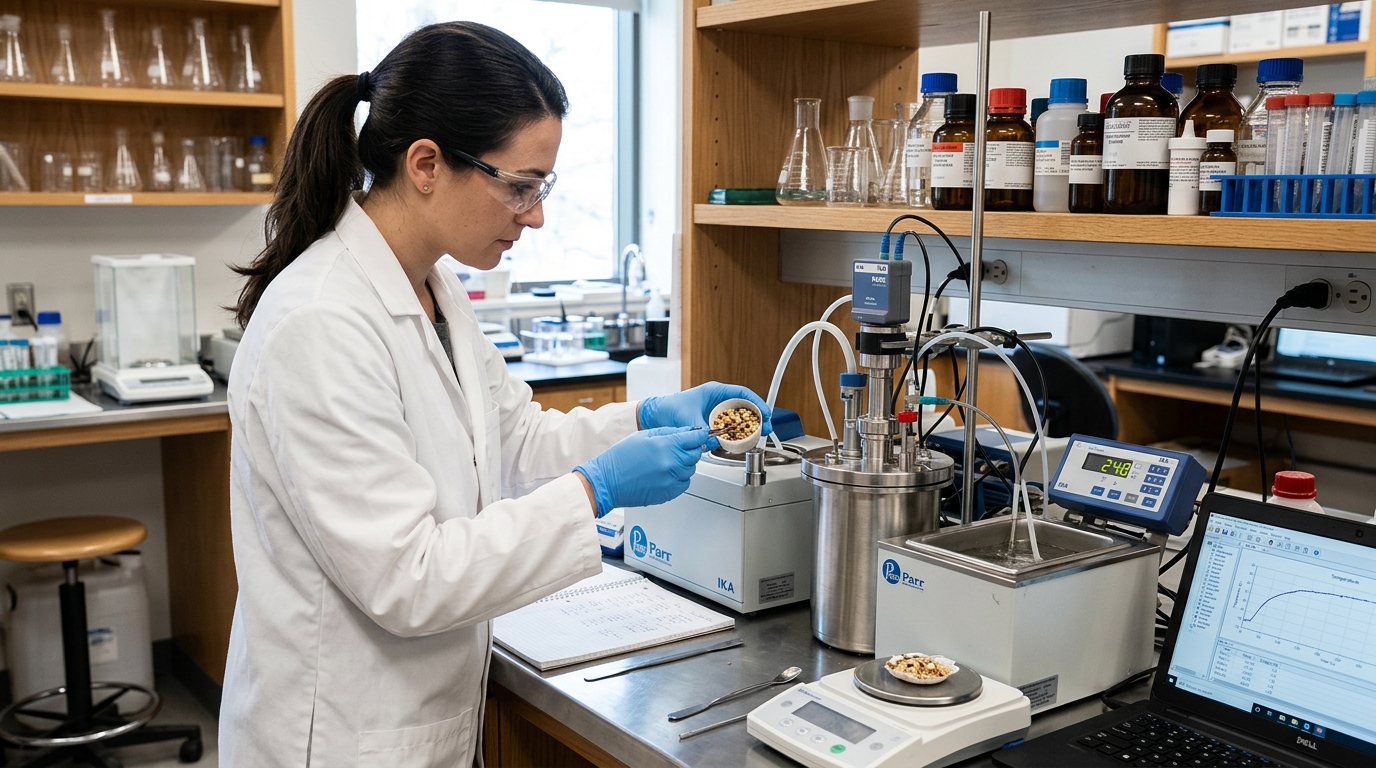
Food scientists use a device called a bomb calorimeter to measure calories. They place a dried food sample in a sealed container, add oxygen, and ignite it. The heat released raises the temperature of surrounding water. The change in temperature tells you the energy content. For instance, a gram of pure fat raises the water temperature more than a gram of carbohydrate. That’s why fat has more calories per gram.
In practice, the calorie counts on labels are often calculated using the Atwater system rather than direct measurement. Manufacturers multiply the grams of protein, carbs, and fat by 4, 4, and 9, then sum them. This method is faster and cheaper. But it can be off by 5 to 10 percent compared to bomb calorimetry. The FDA allows up to 20 percent error for labeled calories. So that 200-calorie snack might actually give you 220 or 180.
Why Cooking Changes Calorie Availability
Cooking can alter how many calories your body actually extracts from food. A 2015 study in the American Journal of Clinical Nutrition found that cooking increases the energy available from meat and carbohydrates. For example, raw starch is harder to digest than cooked starch. In one experiment, mice fed cooked meat gained more weight than those fed raw meat, even though the calorie content was the same. Processing food also makes calories more accessible. That’s why a whole almond gives you fewer usable calories than almond butter, because the cell walls in whole almonds trap some fat.
Calories and Human Energy Expenditure
Your body burns calories through three main pathways. Basal metabolic rate (BMR) accounts for 60 to 75 percent of daily calorie burn. It’s the energy you need at rest to keep your heart beating, lungs breathing, and cells functioning. The average woman burns about 1,400 to 1,600 kcal per day at rest; the average man burns 1,800 to 2,000 kcal. Physical activity adds another 15 to 30 percent. The thermic effect of food (TEF) uses about 10 percent of your intake to digest and absorb nutrients.
Total daily energy expenditure (TDEE) varies widely. A sedentary office worker might burn 1,800 kcal per day. A Tour de France cyclist can burn over 8,000 kcal during a single stage. That’s why calorie needs are personal. The 2,000-calorie diet on food labels is just a reference value, not a recommendation. The FDA based it on surveys from the 1990s. Your actual needs depend on age, sex, weight, height, and activity level.
How Many Calories Do You Need?
The Dietary Guidelines for Americans 2020-2025 estimate daily calorie needs as follows:
- Sedentary women aged 19-30: 1,800-2,000 kcal
- Active women aged 19-30: 2,400 kcal
- Sedentary men aged 19-30: 2,400-2,600 kcal
- Active men aged 19-30: 3,000 kcal
- Sedentary women aged 51+: 1,600 kcal
- Sedentary men aged 51+: 2,000-2,200 kcal
These are rough guides. You can estimate your own TDEE using the Mifflin-St Jeor equation. For women: (10 × weight in kg) + (6.25 × height in cm) – (5 × age in years) – 161. For men: same formula but add 5 instead of subtracting 161. Then multiply by an activity factor (1.2 for sedentary, 1.55 for moderate, 1.9 for very active).
Calories and Weight Management
Weight change comes down to energy balance. Eat more calories than you burn, and you store the excess as fat. Eat fewer, and you burn stored fat. A pound of body fat contains roughly 3,500 kcal. So a deficit of 500 kcal per day should lead to about 1 pound of loss per week. But real life is messier. The 3,500-calorie rule is an approximation. As you lose weight, your BMR drops, and you burn fewer calories. That’s why weight loss slows over time.
Not all calories affect your body the same way. A 2019 study in Cell Metabolism found that people on a low-carb diet burned 200 to 300 more calories per day than those on a low-fat diet, even after weight loss. The source of calories matters for hormones, appetite, and metabolic rate. Protein, for example, has a higher thermic effect (20-30 percent) than carbs (5-10 percent) or fat (0-3 percent). So 100 calories of chicken breast costs your body more to process than 100 calories of olive oil.
Quality vs. Quantity
You can lose weight on a diet of Twinkies if you eat fewer calories than you burn. But you won’t be healthy. Nutrient-dense foods like vegetables, fruits, lean proteins, and whole grains provide vitamins, minerals, and fiber. They also keep you full. A 2018 study in JAMA found that people who ate minimally processed foods consumed 500 fewer calories per day than those on an ultra-processed diet, without trying. The processed group gained about 2 pounds in two weeks; the unprocessed group lost about 2 pounds.
In practice, counting calories can help with awareness, but it’s not for everyone. It can lead to obsessive behavior. A better approach for many is to focus on food quality and portion sizes. The Mediterranean diet, for example, doesn’t require calorie counting yet is linked to better heart health and weight management. A 2020 review in Nutrients found that Mediterranean diet adherence was associated with a 25 percent lower risk of obesity.
Common Misconceptions About Calories
One myth is that calories from sugar are worse than calories from fat. In terms of energy, they’re the same. But sugar can spike insulin and promote fat storage, especially in large amounts. Another myth is that eating after 8 p.m. causes weight gain. Total intake matters more than timing. A 2017 study in the American Journal of Clinical Nutrition found no difference in weight loss between people who ate their largest meal at breakfast versus dinner, as long as calories were equal.
Some people think that burning 3,500 calories through exercise alone will melt away a pound of fat. But exercise burns fewer calories than you think. Running a mile burns about 100 kcal for the average person. To burn 3,500 kcal, you’d need to run 35 miles. That’s why diet is more effective for weight loss than exercise alone. Exercise is still crucial for heart health, muscle mass, and mental well-being, but it’s not a magic calorie burner.
Conclusion
A calorie is a unit of energy, specifically the heat needed to raise 1 gram of water by 1 degree Celsius. In nutrition, we use kilocalories, each equal to 1,000 small calories. Your body burns calories through metabolism, activity, and digestion. Eat more than you burn, and you gain weight; eat less, and you lose it. But the type of calories you eat affects hunger, hormones, and health. Focus on whole foods, watch portion sizes, and move your body. That’s the practical takeaway.
Q: Is a calorie a unit of energy or weight?
A calorie is a unit of energy, not weight. It measures the amount of heat needed to raise water temperature. When people talk about calories in food, they mean kilocalories, which are 1,000 small calories. Your body uses this energy for everything from breathing to running.
Q: Why do food labels say “Calories” instead of “kilocalories”?
In the U.S., food labels use “Calories” with a capital C to mean kilocalories. This is a shorthand that’s been used for decades. In other countries, like Australia, labels show kilojoules instead. One kilocalorie equals 4.184 kilojoules. So 100 Calories is the same as 100 kcal or 418 kJ.
Q: Do calories from different foods affect my body differently?
Yes, the source matters. Protein burns more calories during digestion than fat or carbs. Fiber slows digestion and keeps you full. A 2019 study found that low-carb diets burned 200 to 300 more calories daily than low-fat diets. So while a calorie is a calorie in a lab, your body handles them differently.
Q: How many calories should I eat to lose weight?
It depends on your TDEE. A safe deficit is 500 kcal per day, which may lead to about 1 pound of loss per week. But that’s an estimate. Women should not go below 1,200 kcal per day; men not below 1,500, unless supervised by a doctor. Use an online calculator to find your maintenance calories.
Q: Can I trust the calorie counts on food packages?
They’re close but not exact. The FDA allows up to 20 percent error. Most counts are calculated using the Atwater system, which multiplies grams of protein, carbs, and fat by 4, 4, and 9. Cooking and processing can change how many calories you actually absorb. So treat labels as estimates, not gospel.