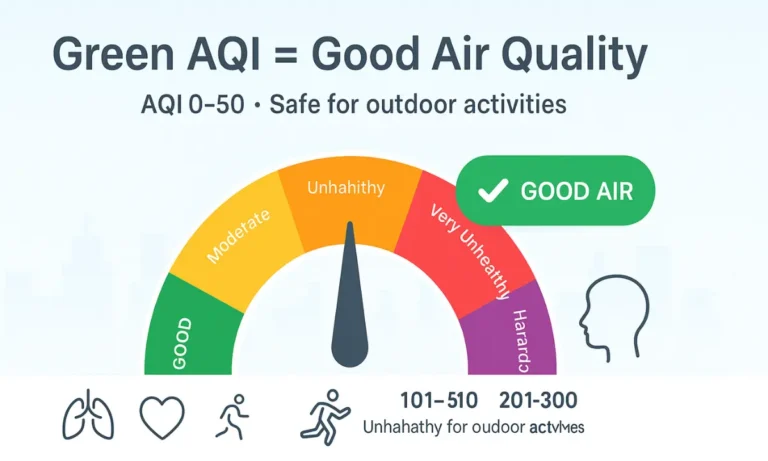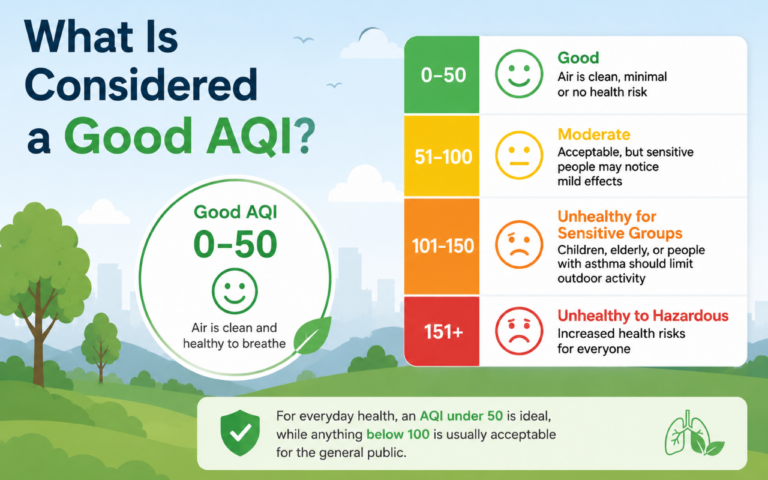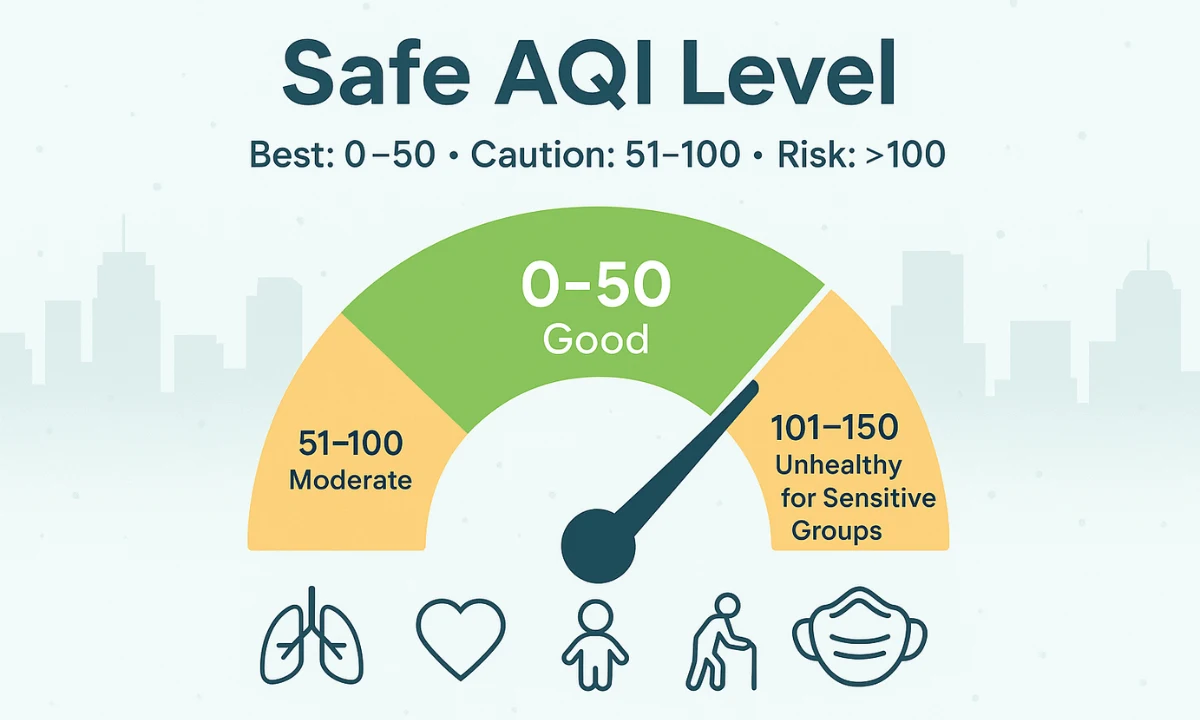
A safe AQI level is 0–50, which means the air is clean and healthy to breathe.
At this level, outdoor activities are safe for everyone, including children, older adults, and people with asthma or heart conditions. No special precautions are needed when the AQI stays in this range.
Air is the one thing we “consume” nonstop, every breath, every minute. Yet air quality often stays invisible until it becomes a problem. Urban traffic, industrial emissions, construction dust, seasonal crop burning, and climate-driven wildfires can all worsen pollution, sometimes overnight.
That’s why people frequently ask: What is a safe AQI level?
Because AQI isn’t just a weather-app number – it’s a practical health signal. Knowing the healthy air quality range helps you decide whether it’s smart to go for a run, let kids play outside, open windows, or take extra precautions if someone at home has asthma or heart disease.
In this guide, you’ll learn:
- What AQI means and how it’s measured
- What is a safe AQI level for daily life?
- Health effects across the AQI ranges
- Safer ranges for children, the elderly, and respiratory/cardiac patients
- Indoor vs outdoor air quality safety
- Simple, effective protection steps during polluted days
What Is AQI?
AQI (Air Quality Index) is a standardized index that communicates how clean or polluted the air is, and what health effects might occur. It compresses complex pollution measurements into one easy-to-read number.
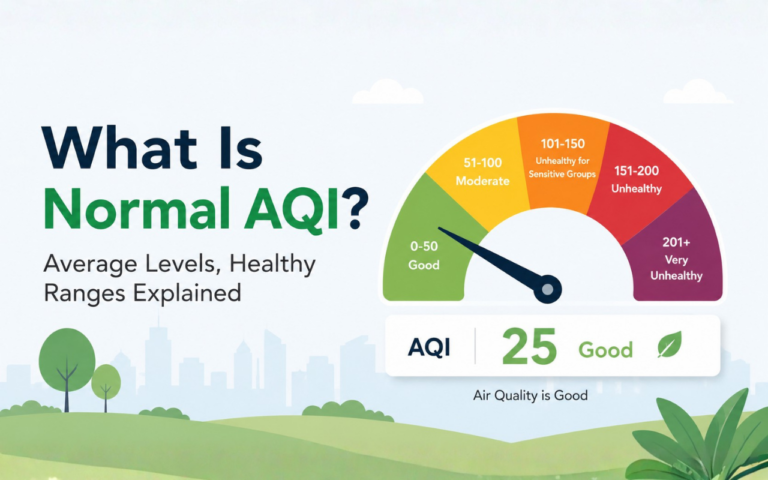
AQI typically ranges from 0 to 500:
- Lower values = cleaner air
- Higher values = more pollution and a higher health risk
How AQI Is Calculated
Air monitoring stations measure multiple pollutants in the atmosphere. Each pollutant is converted into an AQI sub-score, and the highest sub-score becomes the AQI for that location and time.
So, AQI is driven by the “worst” pollutant at that moment.
This matters because air might look “fine” but still have high PM2.5 or ozone both can be harmful even when invisible.
Major Pollutants Included in AQI
AQI commonly includes:
- PM2.5 (fine particles)
- PM10 (coarse particles)
- Ozone (O₃) (ground-level ozone)
- Nitrogen Dioxide (NO₂)
- Sulfur Dioxide (SO₂)
- Carbon Monoxide (CO)
PM2.5 is often the most concerning because it can penetrate deep into the lungs and enter the bloodstream, linking to respiratory problems and cardiovascular strain.
What Is a Safe AQI Level for Humans?
The question “What is a safe AQI level?” usually means: At what AQI can most people breathe and function normally without added risk?
In general:
- 0–50 is considered healthy/low-risk for nearly everyone
- 51–100 is acceptable for most people, but not “ideal” air
- Above 100, risk rises, especially for sensitive groups
AQI Scale Explained (0–500)
Here’s a clean, SEO-friendly table you can publish as-is:
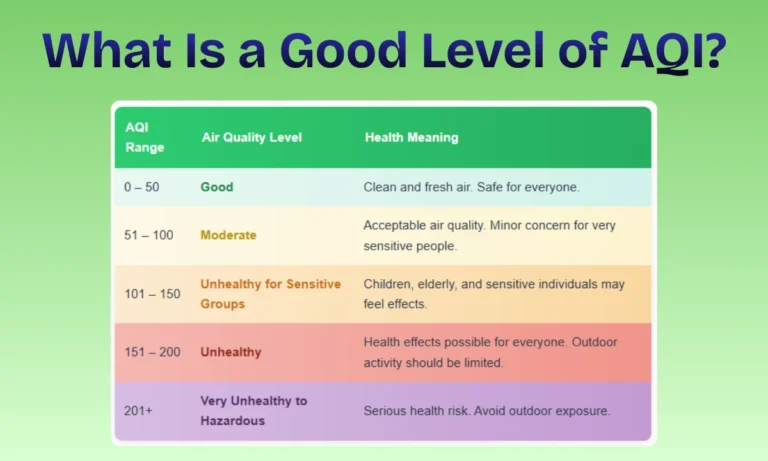
| AQI Range | Category | What It Means for Health |
| 0–50 | Good | Clean air; minimal risk; safe for outdoor activities |
| 51–100 | Moderate | Acceptable for most; sensitive people may notice mild symptoms |
| 101–150 | Unhealthy for Sensitive Groups | Risk increases for children, the elderly, asthma/heart patients |
| 151–200 | Unhealthy | Health effects are possible for everyone; sensitive groups are affected more |
| 201–300 | Very Unhealthy | Serious health risks; limit outdoor exposure strongly |
| 301–500 | Hazardous | Emergency conditions: Avoid outdoor exposure as much as possible |
Safest AQI Range
If you ask What is a safe AQI level, the most protective answer is: AQI 0–50.
At AQI 0–50:
- Outdoor activity is generally safe
- Lungs and heart face minimal stress
- No special precautions are needed for most people
- It’s the best baseline for “healthy air quality.
Is AQI 51–100 Still “Safe”?
AQI 51–100 is often okay for healthy adults. But it’s not “ideal air,” especially if exposure is long or activity is intense.
At AQI 51–100:
- Normal outdoor activities are usually fine
- Sensitive individuals may experience mild irritation
- Long, intense workouts can increase pollutant intake
- People with asthma/allergies may need caution
So, it may be acceptable, but when someone asks What is a safe AQI level, “Good (0–50)” remains the best benchmark.
Why These AQI Levels Are Considered “Safe” (Science-Informed Explanation)
Air quality categories are based on health research linking pollutant exposure to outcomes like:
- Asthma flare-ups
- Bronchitis symptoms
- Reduced lung function
- Increased cardiovascular strain
- Higher hospital visits on polluted days
Two key ideas explain why “lower AQI is safer”:
- Dose matters
The more polluted air you breathe (and the longer you breathe it), the higher the health burden—especially for PM2.5. - Breathing rate matters
Exercise increases breathing rate and depth, pulling more pollutants deep into the lungs. That’s why “moderate AQI” might be okay for walking but not ideal for intense running.
This is why the safest guidance tends to recommend staying closer to AQI 0–50 whenever possible.
Health Effects of Different AQI Levels
AQI 101–150: Unhealthy for Sensitive Groups
This range can cause symptoms in:
- children (developing lungs)
- elderly (weaker respiratory/cardiac reserve)
- pregnant individuals (added physiological stress)
- asthma/COPD patients
- people with heart conditions
Possible symptoms:
- Throat irritation
- Coughing, wheezing
- Mild shortness of breath
- Fatigue or headache
Practical guidance:
Sensitive groups should reduce prolonged outdoor exposure and avoid heavy exertion.
AQI 151–200: Unhealthy for Everyone
At this stage, what is a safe AQI level no longer applies to typical outdoor routines.
Common effects:
- Noticeable breathing discomfort during activity
- Worsened asthma symptoms
- Chest tightness in sensitive individuals
- Greater cardiovascular strain in high-risk groups
Practical guidance:
Limit outdoor time, keep activity light, and protect vulnerable people first.
AQI 201+: Very Unhealthy to Hazardous
At AQI above 200:
- Respiratory symptoms become more likely even in healthy adults
- Heart risk increases, especially for older adults
- Children should avoid outdoor play
- Outdoor exercise should be avoided
At hazardous levels:
- Treat it like an environmental emergency day
- Reduce exposure as much as realistically possible
Safe AQI Levels for Specific Groups
Safe AQI for Children
Children are more vulnerable because:
- They breathe faster
- Their lungs are still developing
- They spend more time playing outdoors
Best range: 0–50
Caution range: 51–100 (watch for irritation)
Avoid outdoor play: above 100, especially prolonged play
Avoid entirely: above 150 if possible
Practical tip: if kids are coughing, rubbing eyes, or tired quickly outdoors – reduce exposure even if AQI isn’t “extreme.”
Safe AQI for Elderly People
Older adults may have reduced lung capacity and higher cardiovascular vulnerability.
Best range: below 50
Use caution: 51–100 (especially if heart disease exists)
Limit exposure strongly: above 100
Avoid heavy exertion: above 100 at any age, but especially the elderly
Safe AQI for Asthma and Heart Patients
For asthma, COPD, or heart conditions, safe air quality is stricter.
If you’re asking What is a safe AQI level for high-risk patients, aim for:
- 0–50 whenever possible
- Be cautious at 51–100
- Avoid prolonged exposure above 100
- Consider staying indoors above 150
Practical note: If rescue inhaler use increases on polluted days, treat that as a “red flag,” even if AQI is not extremely high.
Indoor vs Outdoor AQI: What’s the Difference?
Outdoor AQI measures ambient air outside. Indoor air quality depends on:
- Outdoor infiltration
- Ventilation patterns
- Cooking smoke
- Dust and mold
- incense/candles/smoking
- building materials and cleaning chemicals
Indoor air can be better than outdoor (with filtration), or worse (poor ventilation + indoor sources).
What Is a Safe Indoor AQI Level?
A good target is:
- AQI 0–50 indoors, especially for sleeping and for vulnerable people
- Keep fine particles low (PM2.5 ideally in a “clean” range)
Why indoor matters: you spend most of your time indoors, so even mild pollution inside can become significant over many hours.
How to Improve Indoor Air Quality (Practical Steps)
- Use a high-quality air purifier (HEPA-grade filtration is ideal)
- Seal obvious leaks during high pollution days
- Ventilate smartly: open windows only when outdoor air improves
- Avoid indoor smoke sources (smoking, incense, candle overuse)
- Use exhaust fans during cooking
- Clean dust regularly (especially fabrics and carpets)
How to Check AQI in Your Area (Daily Habit)
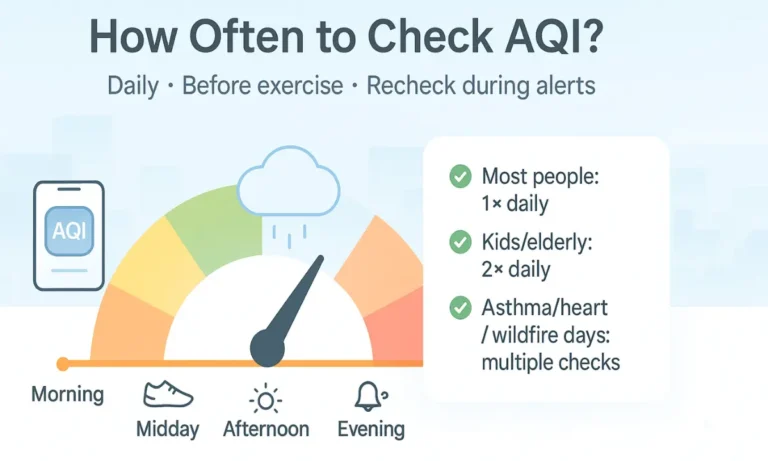
To answer “Is it safe today?” build a daily routine:
- Check AQI in the morning and before outdoor exercise
- Compare trends (rising vs falling)
- Note which pollutant is driving AQI (PM2.5 vs ozone, etc.)
This daily check helps you decide: What is a safe AQI level today for my activities?
How to Protect Yourself When AQI Is High
Recommended Actions (Effective + Realistic)
- Wear a well-fitted N95/KN95 mask outdoors when pollution is high
- Reduce outdoor time, especially for kids and the elderly
- Switch workouts indoors
- Keep windows closed when the outdoor AQI is poor
- Use an air purifier in the room where you spend most of your time
- Hydrate and monitor symptoms (cough, wheeze, chest tightness)
Actions to Avoid
- Outdoor running/cycling in high AQI
- Long walks near heavy traffic
- Opening windows during peak pollution hours
- Letting children play outside when the AQI is unhealthy
Common Myths About AQI
Myth 1: “If I can’t see pollution, the air is safe.”
False. Fine particles (PM2.5) and some gases are invisible but still harmful. Clear skies don’t always mean clean air.
Myth 2: “Only big cities have unsafe air.”
False. Rural areas can suffer from crop burning, dust storms, and wildfire smoke, sometimes reaching very unhealthy levels.
Frequently Asked Questions (FAQs)
What is a safe AQI level?
The safest range is AQI 0–50 (Good air quality).
Is AQI 100 bad for health?
Often acceptable for healthy adults, but sensitive individuals may notice symptoms and should limit prolonged or intense outdoor activity.
Can I exercise outdoors at AQI 80?
Light exercise is usually okay, but intense workouts are better avoided especially if you have asthma or allergies.
What AQI level is dangerous for the lungs?
Risk rises notably above 150, where irritation and breathing discomfort become more common.
What is the safest AQI level for sleeping?
Aim for an indoor AQI of 0–50, especially for children, the elderly, and people with asthma.
In today’s polluted world, understanding what a safe AQI level is helps you protect your lungs, heart, and long-term health. AQI is not just an environmental metri – it’s a daily decision tool.
By monitoring AQI, reducing exposure on bad-air days, and improving indoor air quality, you can significantly reduce health risks for yourself and your family.
Medical & Safety Disclaimer (YMYL Compliance)
This article is for informational purposes only and does not replace professional medical advice. If you have asthma, COPD, heart disease, or severe symptoms during pollution events, consult a qualified healthcare professional.