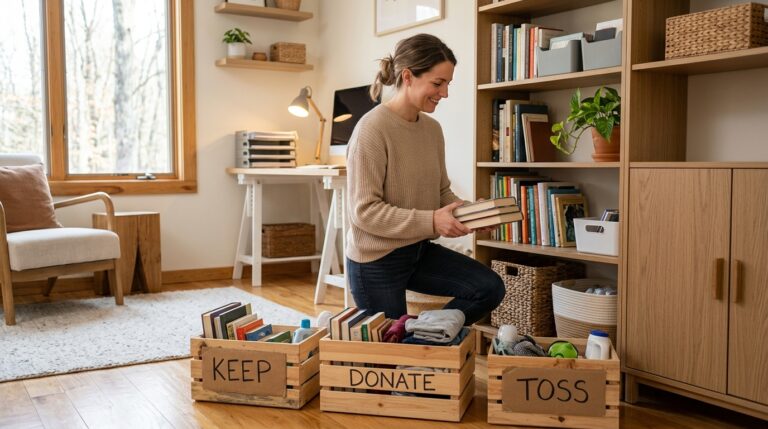
What Is the 5S Method for Organizing a Home? A Simple Guide
The 5S method sounds like it belongs on a factory floor, not in your kitchen drawer. But the five-step system Toyota developed in the 1950s works just as well on a cluttered closet as it does on an assembly line. The idea is simple: give every item a place, keep that place clean, and build habits so the system holds. Marie Kondo asks whether something sparks joy. 5S asks whether it belongs, where it lives, and who keeps it there.
Home organizers have borrowed the method for years. Professional organizer Cassandra Aarssen, author of Real Life Organizing, uses a version of it with clients who feel overwhelmed by traditional decluttering advice. The difference is that 5S doesn’t stop at getting rid of stuff. It builds a repeatable routine so the mess doesn’t return in six weeks.
The Five S’s, Translated for Your Home
The original Japanese terms are seiri, seiton, seiso, seiketsu, and shitsuke. Most English versions call them Sort, Set in Order, Shine, Standardize, and Sustain. Each step builds on the last, so skipping one usually means the whole system collapses.
1. Sort (Seiri)
Sort means removing everything that doesn’t belong in a space. In manufacturing, workers use red tags to mark items that need to be moved or discarded. You can do the same at home. Grab a box, label it “Not Sure,” and put anything you haven’t used in 12 months inside. Seal it with tape and write the date on top. If you haven’t opened it in six months, donate it without looking inside.
In practice, the biggest mistake is sorting by room instead of by category. A pair of scissors in the garage, the kitchen, and the bathroom is three sets of scissors. Gather all of them in one place, keep two, and you’ve solved a problem you didn’t know you had.
2. Set in Order (Seiton)
This step is about placement. The rule is simple: the more often you use something, the closer it should be to where you use it. A study published in the Journal of Occupational and Environmental Medicine found that office workers spend roughly 4.3 hours per week just looking for things. Home is no different. If you’re hunting for the tape measure every time you need it, it isn’t set in order.
Try labeling shelves with a label maker or masking tape. It feels fussy. It works. A 2019 study in the Journal of Environmental Psychology found that visual clutter competes for attention and raises cortisol levels, so clear labels reduce the mental load of searching.
3. Shine (Seiso)
Shine means cleaning, but it’s really about inspection. While you wipe down a shelf, you notice the leaky bottle, the dead battery, the expired coupon. Japanese factories call this cleaning as inspection. At home, it turns a chore into a quick audit.
Set a 15-minute timer once a week and clean one zone. The bathroom counter, the entryway bench, the top of the fridge. Small and frequent beats a four-hour deep clean every spring.
4. Standardize (Seiketsu)
Standardize means writing down what good looks like. If your kids don’t know where the lunchboxes go, they’ll put them anywhere. A printed photo of the correctly organized shelf taped inside the cabinet door solves this in seconds.
Try these standards:
- One in, one out: buy a new mug, remove an old one the same day.
- Every item returns to its labeled home before bed.
- Weekly 15-minute zone clean on a set day, like Sunday evening.
- A visible checklist on the fridge for shared spaces.
5. Sustain (Shitsuke)
Sustain is the hardest S. It’s the habit that keeps the other four alive. The trick is to attach maintenance to an existing routine. You already brush your teeth twice a day. Add a two-minute counter reset right after. Behavioral scientists call this habit stacking, and a 2019 PLOS ONE review of habit formation found that anchoring new behaviors to existing routines is one of the strongest predictors of long-term adherence.
Set a recurring phone reminder for the first 30 days. After that, the routine tends to stick on its own.
A Room-by-Room Example: The 5S Kitchen
Kitchens are the best place to start because so many small items pile up. Here’s how the method plays out in a typical 10-foot galley kitchen.
- Sort: Empty every drawer onto the counter. Toss expired spices, duplicate spatulas, and the bread maker you used once in 2018.
- Set in Order: Keep the items you use daily within arm’s reach of the stove. Move the holiday cookie cutters to a high shelf.
- Shine: Wipe the drawer liners and check for crumbs or leaks while everything’s out.
- Standardize: Label each drawer with a photo inside the cabinet door. “Utensils,” “Baking,” “Sharp Things.”
- Sustain: Do a 5-minute drawer reset every Friday before the grocery run.
Most people finish a kitchen in a weekend. A whole house takes longer. Budget one room per week for two months, and you’ll cover a 2,000-square-foot home without burnout.
Why 5S Works Better Than One Big Declutter
The average American home contains about 300,000 items, according to a widely cited estimate from the Los Angeles Times. That number is hard to picture, but the point is clear: stuff accumulates faster than most people can manage it. A one-time purge doesn’t fix the system that caused the clutter.
5S builds a feedback loop. Shine surfaces problems. Standardize prevents them. Sustain keeps the whole thing running. Home organizer and author Joshua Becker, who runs the Becoming Minimalist blog, has said the goal isn’t a perfectly empty house. It’s a home where things work. That’s exactly what 5S delivers.
It also scales. A family of four can use the same five steps in a mudroom, a garage, or a home office. Kids as young as six can sort toys into bins and label the shelves with stickers. Try it on a single shelf first. Then expand.
Common Mistakes to Avoid
Most failed 5S attempts share the same three errors. Skipping Sort and jumping straight to buying bins is the first. You end up with expensive containers full of things you don’t need. The second is over-labeling. If every pencil has a label, the system becomes work. The third is trying to do the whole house in one weekend. Fatigue sets in, standards slip, and the clutter wins.
Start with the space that frustrates you most. The junk drawer, the entryway, the kids’ craft shelf. A single win builds momentum for the rest.
Conclusion
The 5S method gives you a structure that ordinary decluttering lacks. Sort, set in order, shine, standardize, and sustain. Five steps, one habit loop, and a home that stays organized because the system does the work, not your willpower. Pick one drawer today and run through all five steps in 20 minutes. That’s the whole method in miniature.
Q: What does 5S stand for in home organizing?
5S stands for Sort, Set in Order, Shine, Standardize, and Sustain. The terms come from Japanese manufacturing: seiri, seiton, seiso, seiketsu, and shitsuke. Each step builds on the last, so most organizers recommend working through them in order rather than jumping around.
Q: How long does it take to 5S a whole house?
Most people need one weekend per room, or about two months for a 2,000-square-foot home. Starting with one small zone, like a junk drawer or entryway, takes 15 to 30 minutes and gives you a feel for the process before committing to bigger spaces.
Q: Is 5S the same as Marie Kondo’s method?
No. Kondo’s KonMari method focuses on whether an item sparks joy and sorts by category across the whole home. 5S focuses on placement, cleaning, and habit-building in specific zones. Kondo helps you decide what to keep. 5S helps you keep it organized long term.
Q: Can kids do the 5S method?
Yes. Children as young as six can sort toys into bins and place stickers on shelves. The visual standards, like photos taped inside cabinet doors, work especially well for kids who can’t read yet. Assign each child one zone to maintain.
Q: What’s the hardest part of 5S at home?
Sustain. The first four steps happen once. Sustain is the ongoing habit that keeps the system from collapsing. Tying maintenance to an existing routine, like a Friday drawer reset before grocery shopping, is the most reliable way to make it stick.