
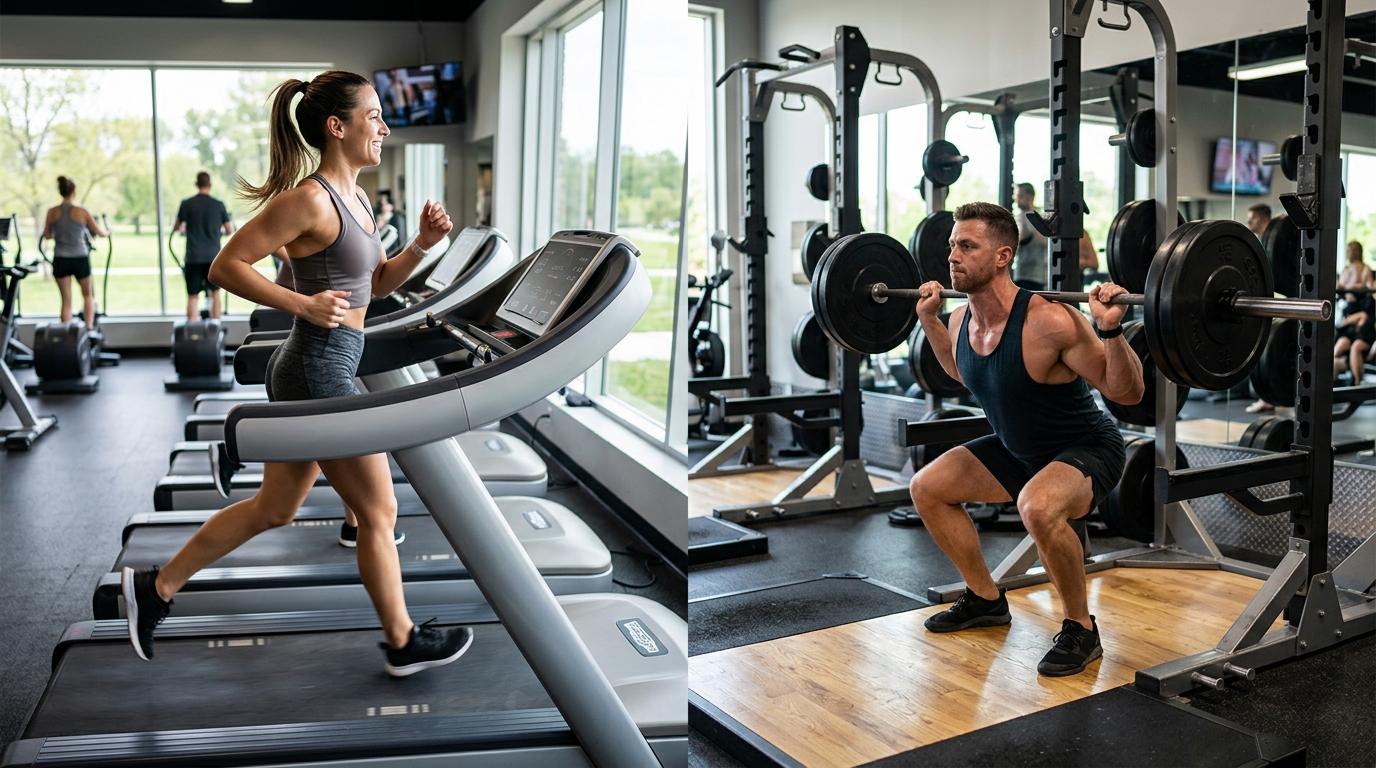
Cardio vs Strength Training: What’s the Difference?
Cardio and strength training are the two pillars of physical fitness, but they work in fundamentally different ways. Cardio, short for cardiovascular exercise, elevates your heart rate and breathing to improve endurance. Strength training, on the other hand, uses resistance to build muscle and power. Understanding these differences helps you pick the right workout for your goals, whether that’s running a 5K or deadlifting twice your body weight.
Cardio: The Endurance Builder
Cardiovascular exercise, also called aerobic exercise, involves continuous movement that raises your heart rate into a target zone for an extended period. Think running, cycling, swimming, or even brisk walking. The primary energy system at work is the aerobic system, which uses oxygen to convert glucose and fat into fuel. A 2019 study in the British Journal of Sports Medicine found that 150 minutes of moderate cardio per week reduces the risk of heart disease by up to 30%. That’s a big return for a simple habit.
What Cardio Does for Your Body
Regular cardio strengthens your heart muscle, increases lung capacity, and improves blood vessel function. It also burns calories efficiently: a 155-pound person running at 6 mph burns about 700 calories per hour, according to Harvard Health Publishing. Over time, cardio lowers resting heart rate and blood pressure. It’s your go-to for endurance, heart health, and mood boost, thanks to endorphin release.
Types of Cardio
- Steady-state: 30 to 60 minutes at a consistent pace, like jogging or cycling.
- HIIT (High-Intensity Interval Training): Short bursts of all-out effort followed by recovery, such as 30 seconds sprinting, 90 seconds walking.
- Low-impact: Swimming, elliptical, or rowing, easier on joints.
Strength Training: The Muscle Builder
Strength training, or resistance training, involves working your muscles against an external force. That force can be free weights, machines, resistance bands, or your own body weight. The goal is to create microtears in muscle fibers, which repair and grow stronger during recovery. A 2020 meta-analysis in Medicine & Science in Sports & Exercise showed that strength training increases muscle mass by 1 to 2 pounds per month in beginners, depending on diet and programming.
What Strength Training Does for Your Body
Lifting weights builds lean muscle, boosts metabolism, and strengthens bones. After age 30, adults lose 3% to 8% of muscle mass per decade without training, a process called sarcopenia. Strength training reverses that. It also improves insulin sensitivity, making it a powerful tool against type 2 diabetes. And it raises resting metabolic rate: each pound of muscle burns roughly 6 calories per day at rest, while fat burns about 2.
Types of Strength Training
- Compound lifts: Squats, deadlifts, bench press, rows. Work multiple muscle groups.
- Isolation exercises: Bicep curls, leg extensions, lateral raises. Target one muscle.
- Bodyweight: Push-ups, pull-ups, lunges. No equipment needed.
Key Differences at a Glance
The table below sums up the main contrasts, but here’s the short version: cardio is about efficiency and endurance, strength is about force and structure.
- Primary energy system: Cardio uses aerobic (with oxygen); strength uses anaerobic (without oxygen) for short bursts.
- Heart rate: Cardio keeps you in 50% to 85% of max heart rate for 20+ minutes; strength spikes heart rate briefly between sets.
- Muscle adaptation: Cardio improves mitochondrial density and capillary networks; strength increases muscle fiber size and neural drive.
- Calorie burn during exercise: Cardio burns more per minute; strength burns less but elevates metabolism for hours after (afterburn effect).
- Recovery time: Cardio can be done daily at moderate intensity; strength needs 48 hours before training the same muscle group again.
In practice, a 30-minute run might burn 300 calories, while a 30-minute lifting session burns around 200. But the lifting session can raise your metabolic rate by 5% to 10% for up to 24 hours, according to a 2018 study in Obesity Reviews. That’s the afterburn effect, and it’s why strength training is often better for fat loss over time.
Which One Should You Do?
It depends on your goals. If you want to run a marathon or improve heart health, prioritize cardio. If you want to build muscle, get stronger, or boost metabolism, prioritize strength. But here’s the catch: doing only one leaves gains on the table.
For Fat Loss
A combination works best. Cardio burns calories during the session; strength preserves muscle so you lose fat, not muscle. A 2021 study in Journal of Sports Sciences found that combining both led to 1.5 times more fat loss than cardio alone over 12 weeks.
For Heart Health
The American Heart Association recommends 150 minutes of moderate cardio or 75 minutes of vigorous cardio per week, plus two strength sessions. That’s the gold standard. Skipping strength means missing out on blood pressure improvements: a 2019 study in Hypertension showed strength training lowered systolic blood pressure by 4 to 5 mmHg.
For Longevity
A 2022 study in British Journal of Sports Medicine tracked 400,000 adults and found that those who did both cardio and strength had a 40% lower risk of all-cause mortality compared to those who did neither. Doing only one cut risk by 20% to 30%. The message is clear: do both.
How to Combine Cardio and Strength Without Overtraining
You don’t need to spend two hours in the gym. Here’s a simple weekly template that works for most people:
- Monday: Strength (upper body) + 10 minutes easy cardio warm-up.
- Tuesday: 30 minutes moderate cardio (run, bike, swim).
- Wednesday: Strength (lower body) + 10 minutes core.
- Thursday: 30 minutes HIIT or intervals.
- Friday: Strength (full body) + 10 minutes mobility.
- Saturday: 45 to 60 minutes low-intensity cardio (hike, long walk).
- Sunday: Rest or active recovery (yoga, stretching).
If you’re short on time, do shorter sessions: 20 minutes of strength followed by 20 minutes of cardio, three times a week. Just don’t do intense cardio right before heavy lifting, as it can reduce your strength output by up to 15%, according to a 2017 review in Sports Medicine.
Common Myths About Cardio and Strength
Myth 1: Cardio kills gains. Not true if you manage volume. A 2019 meta-analysis found that concurrent training doesn’t reduce muscle growth as long as cardio is moderate and not done immediately before lifting.
Myth 2: Strength training makes you bulky. Building large muscles requires a calorie surplus and years of dedicated training. Most people gain 5 to 10 pounds of muscle in a year with consistent work.
Myth 3: You can’t build muscle after 50. A 2018 study in Journal of Applied Physiology showed that adults in their 70s gained muscle at similar rates to younger adults when they started strength training.
Conclusion
Cardio and strength training aren’t rivals. They’re partners. Cardio builds your engine, strength builds your frame. For the best health outcomes, aim for 150 minutes of cardio and two strength sessions per week. Start where you are, pick one thing to improve this week, and build from there. Your heart, muscles, and future self will thank you.
Q: Can I do cardio and strength training on the same day?
Yes, but order matters. Do strength first if your goal is muscle gain, because fatigue from cardio can reduce your lifting performance by up to 15%. If your goal is endurance, do cardio first. Separate sessions by at least 6 hours if possible for best results.
Q: Which is better for losing belly fat?
Neither burns fat exclusively from your belly. Spot reduction is a myth. However, combining both is most effective: cardio burns calories during exercise, while strength training builds muscle that raises your resting metabolism. A 2021 study found the combo led to 1.5 times more fat loss than cardio alone.
Q: How many days a week should I do each?
The American Heart Association recommends at least 150 minutes of moderate cardio or 75 minutes of vigorous cardio per week, plus two or more strength sessions. Most people do well with 3 cardio days and 2 to 3 strength days, adjusting based on goals and recovery.
Q: Does cardio burn more calories than strength training?
During the workout, yes. A 155-pound person burns about 700 calories per hour running at 6 mph, versus roughly 400 calories per hour lifting weights. But strength training creates an afterburn effect that can elevate metabolism by 5% to 10% for up to 24 hours, narrowing the gap.
Q: Can I build muscle with only cardio?
No. Cardio improves endurance and heart health but doesn’t provide the mechanical tension needed to grow muscle. You need resistance training, whether from weights, bands, or bodyweight exercises, to stimulate muscle protein synthesis and increase muscle size and strength.