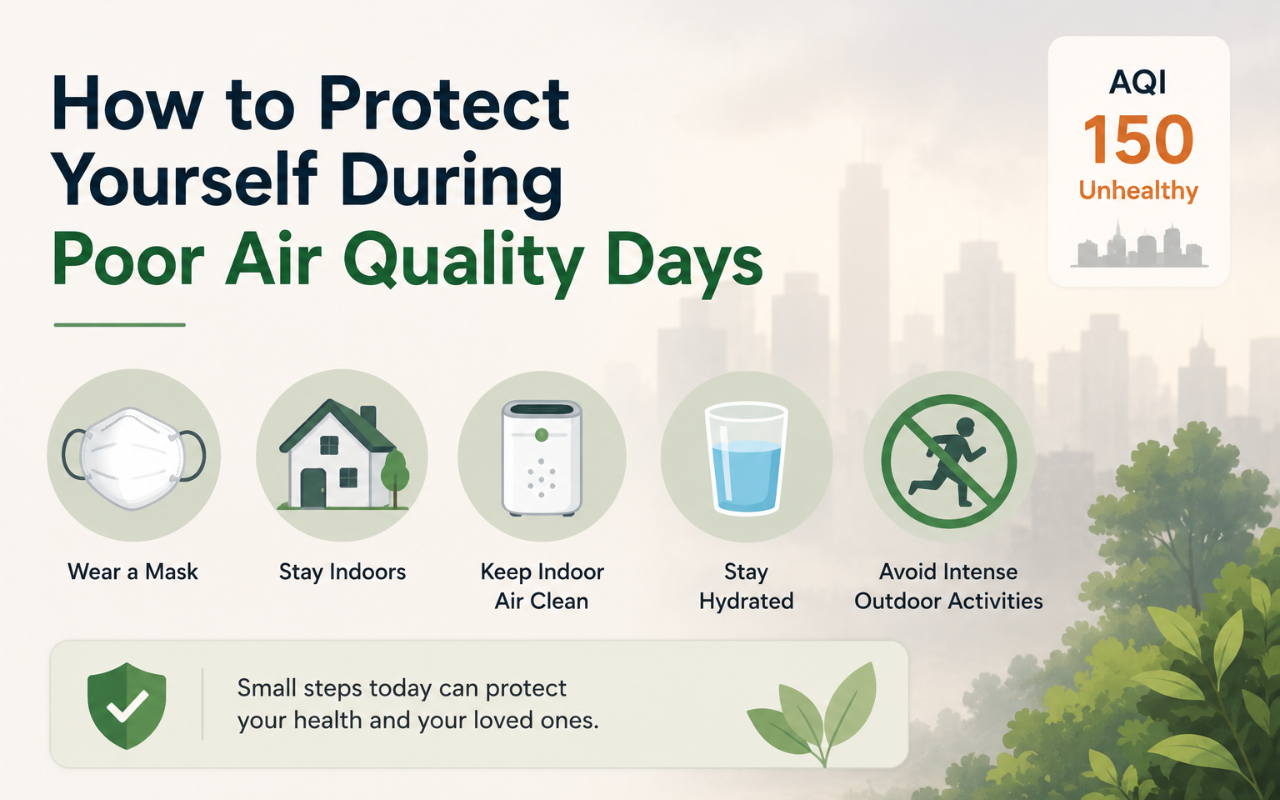
When the air quality index spikes, the risks aren’t always obvious from a glance outside. Wildfire smoke, ground-level ozone, and fine particulate matter can reach dangerous levels without any visible haze. This guide covers what actually works to protect yourself on poor air quality days, from reading AQI alerts correctly to choosing the right mask and cutting your indoor exposure.
What Poor Air Quality Really Means
The US EPA’s Air Quality Index (AQI) runs from 0 to 500 and measures five pollutants: ground-level ozone, PM2.5 (fine particles), PM10 (coarse particles), carbon monoxide, and sulfur dioxide. When the AQI crosses 100, air quality is considered unhealthy for sensitive groups. Above 150, it’s unhealthy for everyone. The number that gets the least attention is PM2.5, particles smaller than 2.5 micrometers in diameter. They’re the ones that travel deepest into your lungs and, according to the World Health Organization’s 2021 Air Quality Guidelines, are linked to cardiovascular disease, lung cancer, and premature death even at exposure levels previously considered safe. Most people look outside and use cloud cover or odor as their guide. That’s not how this works.
How to Check Air Quality Before You Step Outside
You’ll want a real-time AQI source, not a general weather app that sometimes pulls data from monitoring stations hours away. The EPA’s AirNow.gov and its companion app give hyperlocal readings based on the nearest official monitoring station. IQAir’s World Air Quality Index pulls from both government sensors and community-contributed PurpleAir sensors, giving you denser coverage in urban areas. Both are free. Check them before your morning commute, before outdoor exercise, and any time you smell smoke or notice the sky looking yellowish-gray.
A single daily check isn’t enough on active wildfire days. AQI levels can shift by 50 to 100 points within two to three hours as winds change or fires intensify. If you’re in a wildfire-prone region, set up AirNow’s notification alerts so you get a push notification when your zip code crosses a threshold you choose.
What to Do on Poor Air Quality Days
Your actions depend on the AQI level, your health status, and how much time you plan to spend outside. Here’s what each situation actually calls for.
Stay Indoors and Reduce Air Infiltration
Staying indoors helps, but only if you manage how outside air gets in. Most homes exchange air with the outdoors at a rate of 0.35 to 0.5 air changes per hour through gaps, cracks, and natural ventilation. During a wildfire smoke event or a high-ozone afternoon, that constant infiltration pushes your indoor PM2.5 closer to outdoor levels than most people expect. Close windows and exterior doors, and set your HVAC system to recirculate rather than pull in fresh outside air. If your system has a “fresh air intake” damper, disable it temporarily. Research published by Lawrence Berkeley National Laboratory found that step alone can cut indoor PM2.5 levels by 30 to 40 percent during moderate smoke events.
Choose the Right Face Mask
A cloth mask, surgical mask, or neck gaiter doesn’t filter fine particles. If the AQI is above 150 and you need to go outside, you need an N95 or equivalent respirator. N95 masks filter at least 95 percent of airborne particles 0.3 microns or larger when fitted correctly, which is what makes them effective against PM2.5. KN95s (the Chinese standard) and KF94s (the Korean standard) offer comparable filtration, but the key word with any of them is fit. A poorly fitted N95 that gaps at your cheeks or nose bridge will let unfiltered air in regardless of its rating. Press the metal nose strip firmly against the bridge of your nose and do a quick seal check before heading out. If you have a beard, expect leakage with any tight-seal mask.
Manage Indoor Air Quality Too
Nobody talks about this part enough: staying inside on a bad air day only protects you if your indoor air is actually clean. A portable air purifier with a true HEPA filter can reduce indoor PM2.5 by 50 to 90 percent depending on room size and run time. Look for units with a Clean Air Delivery Rate (CADR) at least two-thirds of your room’s square footage in cubic feet per minute. Run it in the room where you spend the most time, keep the door closed, and set it to high during active smoke events. Also avoid indoor pollution sources on these days: skip candles, high-heat cooking without ventilation, and vacuuming, all of which can temporarily spike your indoor particle counts.
How to Prepare Before an Air Quality Alert Hits
You’ll respond faster and better if the basics are already in place. Here’s what to have ready before the next alert.
- Stock N95 respirators before wildfire season: Demand for N95s spikes immediately after air quality alerts are issued, and they sell out locally within hours. Buying a box of 10 to 20 before the season starts means you’re not scrambling when smoke arrives. NIOSH-approved N95s from brands like 3M (model 8210) or Honeywell are widely available online year-round at well under $2 per mask.
- Set up AQI threshold alerts on your phone: AirNow’s app lets you configure push notifications for your zip code based on AQI thresholds you set. Most people don’t know this feature exists. Configure alerts at AQI 100 and 150 so you get advance warning before conditions turn severe.
- Buy a HEPA air purifier sized for your main living space: A unit with a CADR of at least 200 cubic feet per minute handles rooms up to 300 square feet reliably. Don’t wait for fire season to test it. Run it during high-pollen days so you know it’s working and you’ve positioned it correctly in your space.
- Check your HVAC filter’s MERV rating: Standard residential filters run MERV 1 to 8. A MERV 13 filter captures the particle sizes that matter most during smoke events, and most residential systems can handle MERV 11 or 13 without straining the fan. If you’re not sure, ask your HVAC technician before fire season, not during it.
Getting these in place during a non-emergency period takes about two hours total. That prep pays off the moment air quality drops.
Mistakes People Make on Poor Air Quality Days
Most people get some things right and miss others that matter more. Here are the specific errors that create real exposure risk, including a few that aren’t obvious until you see the numbers.
- Exercising outdoors at “moderate” AQI levels: An AQI between 51 and 100 sounds manageable. But exercising at that level means you’re breathing up to four times more air per minute than at rest, pulling in significantly more pollutants per session. If you have asthma or cardiovascular issues, treat anything above AQI 75 as a reason to move your workout indoors. Read more about exercising safely during high pollution days for condition-specific guidance.
- Using a cloth mask and assuming it offers protection: This mistake became widespread after cloth masks were normalized during the COVID-19 pandemic. They don’t filter PM2.5. A standard two-layer cotton mask filters roughly 15 percent of fine particles at best, compared to 95 percent for a properly fitted N95. During wildfire smoke events above AQI 150, the difference between those two numbers matters a lot.
- Assuming your car protects you: Driving with windows up helps, but most vehicles aren’t tightly sealed. EPA research found that vehicle cabins can reach 50 to 80 percent of outdoor PM2.5 concentrations within minutes of driving through smoky air. Switch your car’s ventilation to recirculate mode and replace your cabin air filter on the manufacturer’s schedule, not just when the air smells off.
AQI Levels and What Each One Means for Your Day
The AQI scale breaks into six categories. Here’s a practical read of what each level actually requires from you.
| AQI Range | Category | What to Do |
|---|---|---|
| 0 to 50 | Good | No restrictions. Normal outdoor activity is fine. |
| 51 to 100 | Moderate | Sensitive individuals should reduce prolonged outdoor exertion. |
| 101 to 150 | Unhealthy for Sensitive Groups | Children, elderly, and those with asthma or heart disease should limit outdoor time. |
| 151 to 200 | Unhealthy | Everyone should reduce heavy outdoor exertion. N95 recommended if going outside. |
| 201 to 300 | Very Unhealthy | Avoid outdoor activity. Stay indoors with windows closed and air purifier running. |
| 301 to 500 | Hazardous | Health emergency conditions. Remain indoors. N95 required if evacuation is necessary. |
Who Faces the Highest Risk During Air Quality Events
Poor air quality affects everyone, but the health impact isn’t equal across all groups. Children have faster breathing rates and developing lungs, which means they absorb more pollutants per pound of body weight than adults do. People over 65 often have reduced lung and cardiovascular capacity. Pregnant women face compounding risk: PM2.5 exposure during pregnancy is linked to preterm birth and low birth weight, according to a 2020 review published in Environmental Research. People living with asthma, COPD, or heart failure should treat even moderate AQI alerts as serious events, setting their indoor threshold at AQI 75 rather than 150. If you fall into any of these groups, talk to your doctor about a personalized action plan before the next wildfire season or urban pollution spike, rather than improvising during one.
Conclusion
Protecting yourself on poor air quality days comes down to three things: knowing your real-time AQI source, having the right gear in place before you need it, and not underestimating how much indoor air quality matters. Don’t wait for AQI 200 to close your windows and switch your HVAC to recirculate. Do it at 100. If you’re in a higher-risk group, consult your doctor to get a written air quality action plan specific to your health conditions. The steps aren’t complicated, but they need to be ready before the sky turns orange. For more on managing respiratory health through seasonal pollution events, read our overview of air quality and respiratory conditions.
Frequently Asked Questions
Q: What AQI level is considered dangerous for healthy adults?
The EPA classifies AQI above 150 as unhealthy for everyone, not just sensitive groups. At that level, prolonged outdoor exertion meaningfully increases your intake of fine particles and ozone. Most healthy adults won’t notice obvious symptoms below 150, but the cumulative effect of repeated near-threshold exposure on your cardiovascular and respiratory system is well-documented and worth taking seriously.
Q: Does staying indoors fully protect you from poor air quality?
Not automatically. During a major smoke event, indoor air in most homes can reach 50 to 80 percent of outdoor pollution levels through natural ventilation gaps. You need to actively reduce infiltration by closing windows, setting your HVAC to recirculate, and running a HEPA air purifier. Done right, indoor protection is very effective. Done passively, it’s only partial.
Q: Is an N95 mask necessary, or will a surgical mask work for poor air quality?
For wildfire smoke or PM2.5 pollution above AQI 150, a surgical mask won’t cut it. Surgical masks aren’t sealed against your face and don’t filter fine particles efficiently. You need a NIOSH-approved N95, KN95, or KF94 that fits snugly with no gap at your nose or cheeks. If the mask shifts when you talk or breathe deeply, it’s not protecting you the way it should.
Q: Can I still exercise outdoors on a poor air quality day?
If your AQI is above 100 and you have asthma, heart disease, or you’re pregnant, outdoor exercise isn’t worth the exposure risk on that day. For healthy adults, moderate AQI between 51 and 100 is manageable for light activity but not intense cardio. Vigorous exercise dramatically increases your breathing rate, which means you’re pulling in more pollutants in less time. When in doubt, move the workout indoors.
Q: What’s the difference between PM2.5 and PM10, and which is more harmful?
PM10 refers to particles 10 micrometers or smaller, which includes dust, pollen, and mold spores. PM2.5 refers to particles 2.5 micrometers or smaller, such as smoke and vehicle exhaust. PM2.5 is more harmful because those particles are small enough to bypass your airway defenses and enter your bloodstream directly. The WHO’s 2021 guidelines set the annual PM2.5 safe limit at 5 micrograms per cubic meter, significantly tighter than the EPA’s current 12 microgram standard.