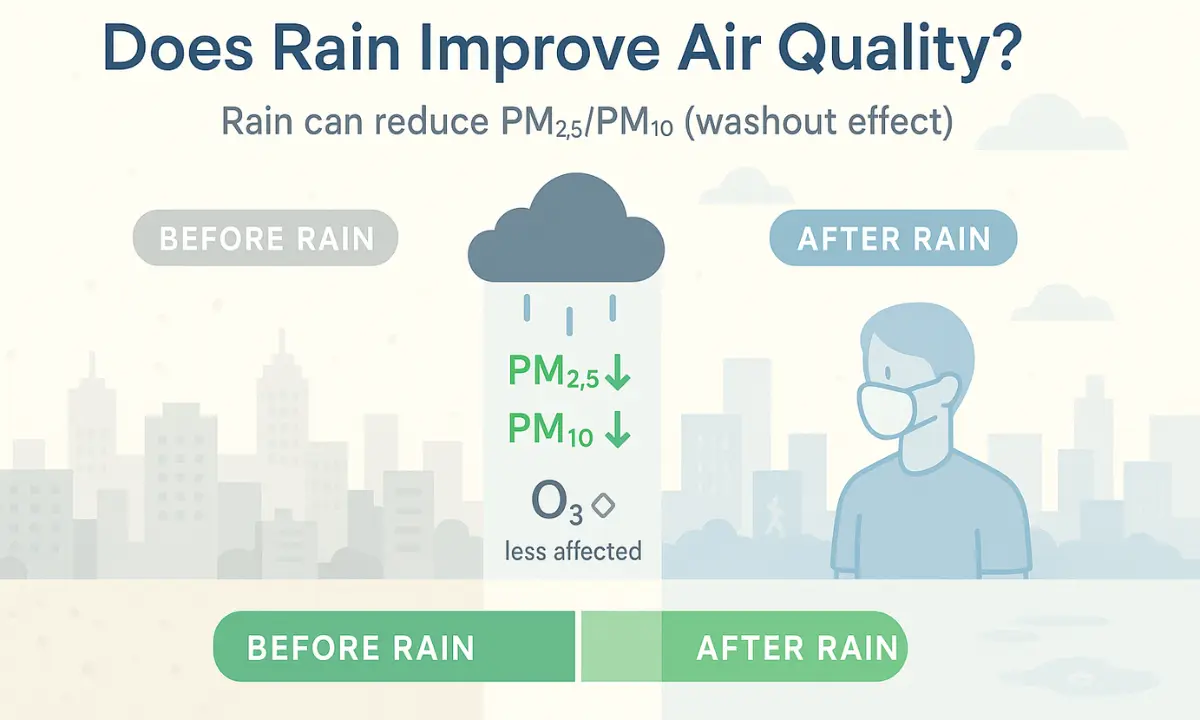
Yes, rain usually improves air quality.
Rain washes dust, smoke, and harmful particles (like PM2.5 and PM10) out of the air, making it cleaner temporarily.
However, this improvement is often short-term, and air quality can worsen again if pollution sources remain.
After rainfall, many people immediately notice clearer skies, improved visibility, and easier breathing. Streets look less dusty, irritation in the throat or eyes may ease, and the air often carries a fresh smell. These everyday observations lead to a common and important question: Does rain improve air quality, or does it only feel that way?
Air pollution, especially fine particulate matter (PM2.5), smoke, dust, and traffic emissions accumulates continuously in many urban and industrial regions. Rain is often described as nature’s air purifier, but its real impact depends on physical processes, weather conditions, and the type of pollutants present. Understanding how rain interacts with pollution helps determine when rain genuinely improves air quality and when its effect is limited or temporary.
Types of Air Pollutants That Accumulate in the Air
Air pollution is a complex mixture of solid particles and gases released from natural and human-made sources. PM2.5, the most dangerous particulate matter, is small enough to penetrate deep into lung tissue and enter the bloodstream, where it can trigger inflammation across multiple organ systems. PM10, while larger, still irritates the airways and reduces breathing efficiency.
Gaseous pollutants such as nitrogen dioxide (NO₂) and sulfur dioxide (SO₂) mainly come from vehicle exhaust and fossil fuel combustion. Ground level ozone (O₃) forms through chemical reactions involving sunlight and precursor gases rather than direct emissions. Smoke from wildfires, agricultural burning, and construction dust further increases pollution load. Each pollutant’s size, weight, and chemical behavior determine how long it remains airborne and how effectively rain can remove it.
Why Pollution Intensifies During Dry and Stagnant Weather
In dry conditions, pollutants accumulate because there is no atmospheric cleansing mechanism. Low wind speeds limit dispersion, while temperature inversions trap polluted air near the ground under warmer air layers above. Continuous emissions from traffic, industry, and heating systems then build up pollution over time, leading to hazy skies and rising AQI values especially in valleys and densely populated cities.
Yes, rain improves air quality, but mainly by reducing particulate pollution, and usually only temporarily.
Rain is effective at removing PM2.5, PM10, dust, smoke, and pollen, but it has a limited impact on gaseous pollutants such as ozone and carbon monoxide. The extent of improvement depends on rainfall intensity, duration, wind conditions, and whether pollution sources continue during and after the rain.
Wet Deposition and Atmospheric Washout (Mechanism Explained)
Rain cleans the air through wet deposition, also called atmospheric washout. As raindrops fall through polluted air, they collide with airborne particles and dissolve water-soluble gases. These pollutants attach to the droplets and are carried down to the surface by gravity.
Because this process directly removes pollutants from the breathing zone, particulate concentrations can drop rapidly during rainfall. This explains why AQI readings often improve in real time and why visibility increases almost immediately during moderate to heavy rain.
Why Particle Size Determines How Effective Rain Is
Particle size plays a critical role in removal efficiency. PM10 particles, being larger, collide more easily with raindrops and settle quickly. PM2.5 particles, although much smaller, are still effectively captured because they remain suspended longer and exist in large numbers. Gaseous pollutants lack a physical structure for easy capture, making them far less responsive to rainfall.
This size-dependent behavior explains why rain improves clarity and breathing comfort but does not eliminate all pollution.
Light Rain vs Moderate vs Heavy Rain (Impact Comparison)
Not all rain cleans the air equally. Drizzle often has minimal impact because raindrops are small and sparse. Moderate rainfall introduces larger droplets and higher density, significantly increasing particle removal. Sustained heavy rain produces the greatest improvement by continuously washing the air and preventing new pollution from accumulating during the event.
Why Long-Duration Rain Produces Better Air Quality
Longer rainfall allows repeated washout cycles. Pollutants removed early in the rain are not immediately replaced, especially if emissions are diluted and dispersed. Over several hours, this leads to substantially cleaner air. Regions with extended rainy seasons often experience consistently lower background pollution levels.
Immediate AQI Response During Rainfall
Air-quality monitoring stations frequently detect sharp drops in PM2.5 and PM10 during rainfall. These changes may appear within minutes on AQI graphs, reflecting the efficiency of wet deposition. For users checking air-quality apps, this shows up as a sudden improvement in AQI color and numerical score.
Why AQI Often Rises Again After Rain Stops
Once rainfall ends, pollution sources such as traffic and industry resume. If wind remains weak and atmospheric mixing is limited, pollutants can rebuild near ground level. This pollution rebound effect explains why air quality may worsen again within hours, showing that rain offers relief, not a permanent fix.
Why Ground Level Ozone Is Resistant to Rain
Ozone is a reactive gas formed by sunlight-driven chemical reactions. Rain does not neutralize ozone or wash it out efficiently. While cloud cover may reduce ozone formation by blocking sunlight, rainfall itself does not eliminate ozone already present in the air.
Why Gaseous Pollutants Persist After Rain
Gases such as carbon monoxide and nitrogen dioxide depend more on emission rates and atmospheric chemistry than precipitation. Rain may slightly dilute them, but their overall concentration remains governed by traffic patterns and industrial output.
Rain Combined with Wind: Maximum Air Quality Benefit
Wind enhances rain’s effect by dispersing pollutants both horizontally and vertically. When rain and wind occur together, pollutants are washed out and prevented from reaccumulating, resulting in the cleanest post-rain air conditions.
Humidity, Cloud Cover, and Optical Haze Effects
High humidity can cause fine particles to absorb moisture and swell, increasing light scattering and haze. This means the air may look hazy even when pollutant mass is lower. Cloud cover, on the other hand, reduces sunlight and slows ozone formation, indirectly improving air quality during rainy periods.
High Humidity and Particle Growth
In very humid conditions, particles grow larger due to moisture absorption. While this can make visibility worse, it does not always mean pollution levels are higher. This optical effect can sometimes mislead people into thinking air quality has deteriorated.
Pollution Rebound After Rainfall
Pollution rebound occurs when air quality worsens again shortly after rain stops. This happens because traffic, industrial activity, and heating emissions resume, while stagnant weather conditions prevent dispersion.
Without wind or continued precipitation, pollutants quickly rebuild near ground level. This rebound effect explains why rain offers temporary relief rather than a permanent solution, reinforcing the importance of emission control alongside natural cleansing processes.
When Outdoor Air Is Safest After Rain
Outdoor air is usually safest immediately after moderate to heavy rainfall, especially when followed by light to moderate wind. During this window, particulate pollution has been washed out, and new emissions have not yet accumulated.
Cooler temperatures and cloud cover also help suppress ozone formation. For outdoor exercise or ventilation, the first few hours after sustained rain typically provide the cleanest and healthiest air conditions
When Rain Does NOT Guarantee Clean Air
Rain does not always ensure healthy air, particularly when ground-level ozone remains high or pollution sources continue operating at full intensity. In heavily industrialized or high-traffic areas, emissions may quickly offset the cleansing effect of rain. Light drizzle is often insufficient to remove fine particles effectively.
Additionally, high humidity can increase haze, making air appear worse even when particle mass is lower. This is why rainfall alone should never be assumed to mean safe air. If ozone remains high or pollution sources continue unabated, air quality may still be unhealthy despite rainfall. Checking AQI is always recommended.
Using AQI Trends Instead of Assumptions
Relying on how the air looks or feels can be misleading, especially after rainfall. The most accurate way to judge air quality is by checking hourly AQI trends before, during, and after rain.
A true improvement shows a consistent downward trend in PM2.5 and PM10 values, not a brief dip followed by a rapid rise. Monitoring AQI data helps distinguish between temporary washout effects and lasting air-quality improvement, making it essential for health-sensitive individuals.
Signs of Genuine Air Quality Improvement
Genuine improvement in air quality is confirmed when PM2.5 and PM10 levels drop significantly and remain low for several hours, not just minutes. Clearer visibility, reduced haze, and the absence of a smoky or dusty smell are strong physical indicators.
People with asthma or allergies often notice easier breathing and less throat or eye irritation, which signals a real reduction in airborne particles. The most reliable confirmation, however, comes from air-quality monitoring data showing sustained AQI improvement, rather than short-term visual clarity.
So, does rain improve air quality?
Yes, rain acts as a natural cleanser by washing particulate pollution out of the atmosphere. However, its benefits are selective, temporary, and dependent on weather conditions. Rain reduces dust, smoke, and fine particles but does not eliminate all pollutants or prevent future buildup.
FAQ:
Does rain really improve air quality?
Yes, rain improves air quality mainly by washing particulate pollutants like PM2.5, PM10, dust, smoke, and pollen out of the air. However, this improvement is usually temporary and depends on rainfall intensity, duration, and wind conditions.
Which air pollutants are reduced by rain the most?
Rain is most effective at reducing particulate matter (PM2.5 and PM10), dust, and smoke. It has limited impact on gaseous pollutants such as ozone (O₃), carbon monoxide (CO), and nitrogen dioxide (NO₂).
Why does air quality often improve quickly during rainfall?
Rain cleans the air through a process called wet deposition, where falling raindrops capture airborne particles and carry them to the ground. This causes PM levels and AQI to drop rapidly, sometimes within minutes.
Why does AQI sometimes worsen again after rain stops?
After rain ends, pollution sources like traffic and industry resume. If wind is weak or the atmosphere is stagnant, pollutants can quickly rebuild near the ground, causing AQI to rise again within hours.
Is air quality always safe after rain?
Not always. While particulate pollution is usually lower after rain, ozone and some gases may remain high. The safest approach is to check real-time AQI readings instead of assuming the air is clean.
FAQ:
Does rain really improve air quality?
Yes, rain improves air quality mainly by washing particulate pollutants like PM2.5, PM10, dust, smoke, and pollen out of the air. However, this improvement is usually temporary and depends on rainfall intensity, duration, and wind conditions.
Which air pollutants are reduced by rain the most?
Rain is most effective at reducing particulate matter (PM2.5 and PM10), dust, and smoke. It has limited impact on gaseous pollutants such as ozone (O₃), carbon monoxide (CO), and nitrogen dioxide (NO₂).
Why does air quality often improve quickly during rainfall?
Rain cleans the air through a process called wet deposition, where falling raindrops capture airborne particles and carry them to the ground. This causes PM levels and AQI to drop rapidly, sometimes within minutes.
Why does AQI sometimes worsen again after rain stops?
After rain ends, pollution sources like traffic and industry resume. If wind is weak or the atmosphere is stagnant, pollutants can quickly rebuild near the ground, causing AQI to rise again within hours.
Is air quality always safe after rain?
Not always. While particulate pollution is usually lower after rain, ozone and some gases may remain high. The safest approach is to check real-time AQI readings instead of assuming the air is clean.
For meaningful protection, rainfall should be combined with emission control, wind dispersion, and continuous AQI monitoring.