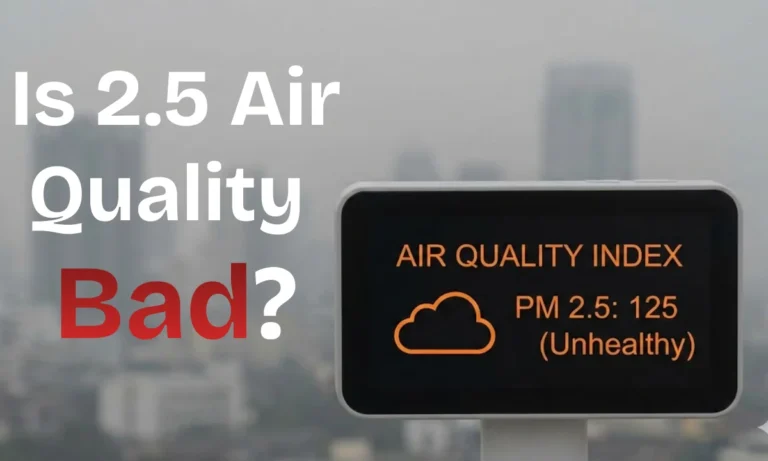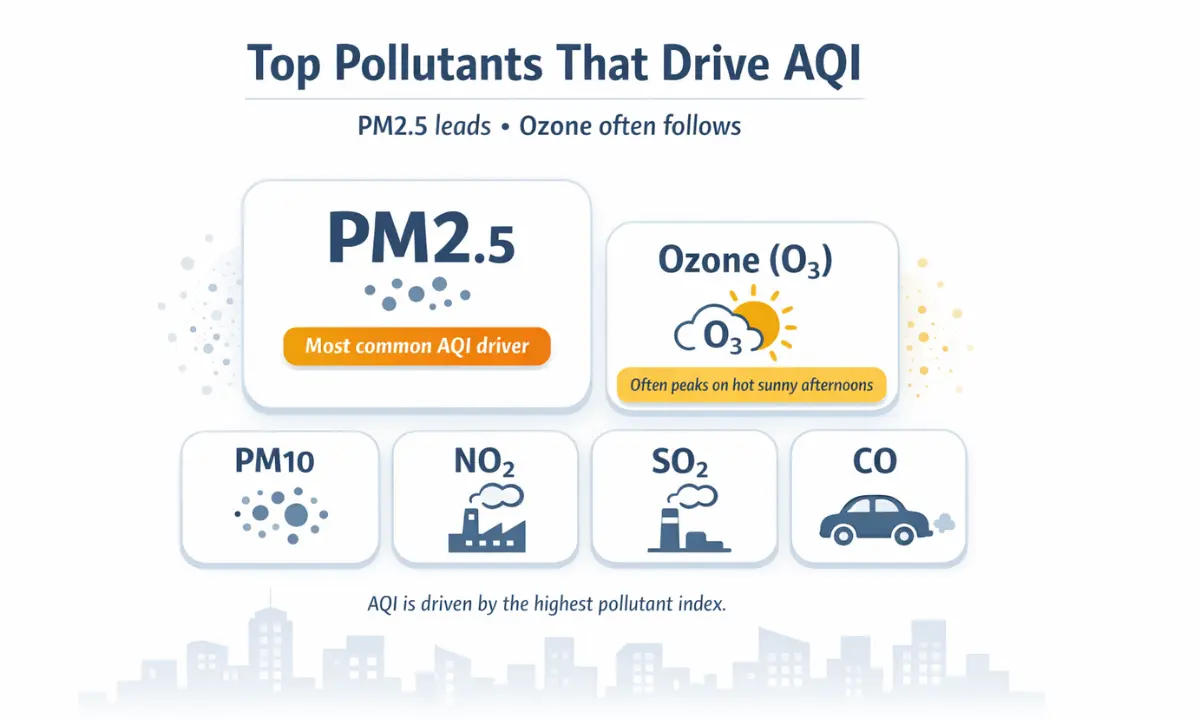
Pollutants that affect AQI the most are PM2.5 and PM10 (fine particles).
Other major contributors include ozone (O₃), nitrogen dioxide (NO₂), sulfur dioxide (SO₂), and carbon monoxide (CO), all of which can harm human health.
When you check the Air Quality Index (AQI), you usually see a single number and a color. Behind that simple display, however, lies a complex mixture of air pollutants with very different sources, behaviors, and health impacts. These pollutants do not affect AQI equally. Some cause rapid AQI spikes and widespread health risk, while others influence air quality only in specific locations or conditions.
This makes one question especially important for everyday health decisions: what pollutants affect AQI the most?
Air pollution has been linked to respiratory disease, cardiovascular stress, neurological effects, weakened immunity, and millions of premature deaths globally. Understanding which pollutants dominate AQI allows people to interpret air-quality reports correctly, recognize genuine danger, and respond with targeted protective actions rather than guesswork.
This guide explains:
- How AQI is calculated and why one pollutant often dominates
- Which pollutants most strongly influence AQI in real-world conditions
- Why are some pollutants more dangerous than others at low levels
- How season, weather, and location change AQI drivers
- The difference between outdoor AQI and indoor exposure
- Practical ways to reduce exposure to the most harmful pollutants
To understand which pollutants affect AQI the most, it is essential to understand how AQI itself works.
Understanding the Air Quality Index (AQI)
The Air Quality Index (AQI) is a standardized public-health communication tool designed to translate complex air pollution data into clear, actionable guidance. AQI values range from 0 to 500, with higher values indicating worse air quality and increasing health risk.
AQI is not simply a pollution score. It is a health based index, meaning the values are tied directly to observed biological effects in humans. Even moderate AQI values can signal increased health stress for vulnerable populations.
How Pollutants Determine the AQI Value (Dominant Pollutant Logic)
AQI is calculated using measurements from several major pollutants, but the final AQI value is determined by the dominant pollutant, the pollutant that produces the highest health based index at that time.
This “winner, takes, all” approach means:
- Multiple pollutants may be present simultaneously
- The pollutant posing the greatest immediate health risk controls the AQI
- AQI reflects risk, not total pollution load
This is why identifying which pollutants most often dominate AQI is more important than tracking all pollutants equally.
Environmental agencies base AQI on six primary pollutants:
- Particulate Matter (PM2.5 and PM10)
- Ground-level Ozone (O₃)
- Nitrogen Dioxide (NO₂)
- Sulfur Dioxide (SO₂)
- Carbon Monoxide (CO)
Although all can influence AQI, real-world data consistently show that PM2.5 and ozone account for the majority of high-AQI events. The remaining pollutants usually dominate AQI only under specific conditions, such as heavy traffic corridors or industrial zones.
Among all pollutants, particulate matter, especially PM2.5 has the most powerful and consistent influence on AQI.
What is PM2.5, and why does it dominate AQI Readings
PM2.5 refers to airborne particles with a diameter of 2.5 micrometers or smaller. Because of their microscopic size, these particles:
- Bypass nasal and throat defenses
- Penetrate deep into the lung tissue
- Enter the bloodstream
- Trigger systemic inflammation
PM2.5 dominates AQI because it combines high toxicity with high persistence. Even relatively small increases in concentration can cause AQI to rise sharply due to the strong health response associated with PM2.5 exposure.
This is why, when people ask what pollutants affect AQI the most, PM2.5 is almost always the correct answer.
PM10: How Coarser Particles Contribute to AQI
PM10 particles are larger and primarily affect the upper respiratory tract. They contribute to AQI increases during:
- Dust storms
- Construction and demolition
- Dry, windy conditions
Although PM10 is harmful, it typically causes shorter-lived AQI spikes and is less biologically penetrating than PM2.5.
Major Sources of Particulate Matter
- Vehicle exhaust (especially diesel engines)
- Industrial emissions
- Wildfires and agricultural burning
- Residential heating and cooking
- Road dust and construction activity
Ozone is the second most important pollutant when evaluating AQI influence.
How Ground Level Ozone Forms
Unlike particulate matter, ozone is not emitted directly. It forms when nitrogen oxides and volatile organic compounds react in sunlight. This makes ozone pollution:
- Highly dependent on the weather
- Strongest during hot, sunny conditions
- More common in summer afternoons
How Ozone Influences AQI and Human Health
Ozone inflames lung tissue, reduces lung capacity, and worsens asthma and other respiratory conditions. During heatwaves, ozone frequently becomes the dominant AQI pollutant, even when particulate matter levels are moderate.
Nitrogen dioxide plays a more localized but still important role in AQI.
Nitrogen Dioxide (NO₂) and Local AQI Impact
Nitrogen dioxide is produced during fuel combustion, mainly from vehicles, buses, and power plants. It is often used as a marker for traffic-related pollution. NO₂ irritates airways and increases asthma risk. While it rarely controls AQI on a regional scale, it can dominate AQI near highways and dense urban centers. NO₂ plays a critical local health role.
Sulfur Dioxide (SO₂) and Industrial AQI Events
Sulfur dioxide primarily affects AQI in industrial regions. Major sources include coal-fired power plants, oil refineries, and metal processing facilities. SO₂ causes short-term respiratory irritation and contributes to secondary particle formation. While less widespread, SO₂ can dominate AQI during industrial accidents or heavy emissions. Its effects are often sharp but localized.
How SO₂ Affects AQI and Health
SO₂ causes short-term respiratory irritation and contributes to the formation of secondary particulate matter. Although less widespread, SO₂ can dominate AQI in industrial zones or during accidental releases.
Carbon monoxide plays a smaller role in AQI but remains biologically dangerous.
Carbon Monoxide (CO) and AQI Contribution
Carbon monoxide is produced by incomplete fuel combustion, especially from vehicles and indoor heating appliances. CO reduces oxygen delivery to the heart and brain, posing serious health risks. It rarely dominates AQI at a regional level but can be significant in traffic corridors or enclosed spaces. CO is more dangerous indoors than outdoors. AQI captures CO risk mainly in localized conditions.
Why PM2.5 Dominates AQI More Than Any Other Pollutant
PM2.5 most often controls AQI because it:
- Appears year round
- Accumulates during stagnant weather
- Has severe health effects at low concentrations
- Travels long distances
- Easily infiltrates indoor spaces
Seasonal and Regional AQI Drivers
- Winter: PM2.5 from heating and trapped air
- Summer: Ozone from sunlight-driven chemistry
- Urban areas: PM2.5 and NO₂
- Rural areas: PM from dust and crop burning
Does AQI Measure Indoor Air Quality?
AQI officially measures outdoor air quality only. However, outdoor pollutants-especially PM2.5-often infiltrate indoor environments. This means outdoor AQI strongly influences indoor exposure. Indoor air quality can sometimes be worse than outdoor air. AQI should be used as a guide for managing both environments. AQI officially measures outdoor air, but outdoor pollutants, especially PM2.5 often penetrate indoor environments.
Why Indoor Exposure Still Matters
Health risk depends on pollution concentration multiplied by exposure duration. Spending many hours indoors with infiltrated PM2.5 can equal or exceed short outdoor exposure. Indoor exposure is often overlooked but highly significant. Proper indoor air management is essential during high AQI. Indoor protection reduces total pollutant dose.Health risk depends on concentration × exposure duration. Spending long hours indoors with infiltrated PM2.5 can equal or exceed short outdoor exposure.
Common Indoor Pollution Sources
Indoor pollution comes from cooking, smoking, vaping, cleaning chemicals, candles, incense, and poor ventilation.
These sources can worsen indoor air even when outdoor AQI improves. During high outdoor AQI, indoor sources compound exposure. Awareness of indoor pollution is critical. Indoor behavior directly affects health outcomes.
Personal Protection Strategies
Limit outdoor activity during high AQI periods. Avoid traffic-heavy areas where PM2.5 and NO₂ are concentrated.
Use properly fitted protective masks when exposure is unavoidable. Adjust activity timing to cleaner air windows. Personal behavior significantly reduces exposure risk.
Home and Lifestyle Measures
- Use HEPA air purifiers
- Ventilate only when the AQI is low
- Reduce indoor combustion sources
Maintain clean living spaces to reduce dust. These measures effectively lower cumulative exposure.
Common Misconceptions About AQI Pollutants
“Only PM2.5 matters.”
PM2.5 is dominant, but ozone and NO₂ can also cause serious harm.
“Dangerous pollution is always visible.”
Many harmful pollutants are invisible.
AQI should never be judged by appearance alone. Understanding pollutant behavior prevents false safety assumptions.
FAQ:
What pollutants affect AQI the most?
Fine particulate matter (PM2.5) affects AQI the most. It dominates most high-AQI events because it is highly toxic at low concentrations, persists in the air, penetrates deep into the lungs, and can enter the bloodstream. Ground-level ozone (O₃) is the second most influential pollutant. Add Image
Why does PM2.5 dominate AQI readings so often?
PM2.5 dominates AQI because it causes strong health effects even at small increases in concentration. It accumulates during stagnant weather, comes from many sources like traffic, wildfires, and heating, and remains airborne for long periods, making it the most consistent driver of AQI spikes.
How does ozone influence AQI differently from particulate matter?
Unlike PM2.5, ozone is not directly emitted. It forms through sunlight-driven chemical reactions involving nitrogen oxides and volatile organic compounds. Ozone typically raises AQI in hot, sunny conditions, especially during summer afternoons and heatwaves.
Do nitrogen dioxide and sulfur dioxide significantly affect AQI?
Nitrogen dioxide (NO₂) and sulfur dioxide (SO₂) can affect AQI but usually dominate only in specific locations. NO₂ is most impactful near heavy traffic areas, while SO₂ influences AQI mainly in industrial or power-generation regions.
Does AQI reflect indoor air pollution as well?
AQI officially measures outdoor air quality, but pollutants especially PM2.5 can easily enter indoor spaces. Prolonged indoor exposure to infiltrated outdoor pollution or indoor sources like cooking and smoking can pose serious health risks even when people stay indoors.
Understanding what pollutants affect AQI the most transforms AQI from a simple number into actionable health information. PM2.5 remains the dominant threat, while ozone, NO₂, SO₂, and CO contribute depending on location and season. By recognizing these patterns, monitoring AQI, and taking targeted precautions, individuals can significantly reduce exposure and protect long-term health.
FAQ:
What pollutants affect AQI the most?
Fine particulate matter (PM2.5) affects AQI the most. It dominates most high-AQI events because it is highly toxic at low concentrations, persists in the air, penetrates deep into the lungs, and can enter the bloodstream. Ground-level ozone (O₃) is the second most influential pollutant.
Why does PM2.5 dominate AQI readings so often?
PM2.5 dominates AQI because it causes strong health effects even at small increases in concentration. It accumulates during stagnant weather, comes from many sources like traffic, wildfires, and heating, and remains airborne for long periods, making it the most consistent driver of AQI spikes.
How does ozone influence AQI differently from particulate matter?
Unlike PM2.5, ozone is not directly emitted. It forms through sunlight-driven chemical reactions involving nitrogen oxides and volatile organic compounds. Ozone typically raises AQI in hot, sunny conditions, especially during summer afternoons and heatwaves.
Do nitrogen dioxide and sulfur dioxide significantly affect AQI?
Nitrogen dioxide (NO₂) and sulfur dioxide (SO₂) can affect AQI but usually dominate only in specific locations. NO₂ is most impactful near heavy traffic areas, while SO₂ influences AQI mainly in industrial or power-generation regions.
Does AQI reflect indoor air pollution as well?
AQI officially measures outdoor air quality, but pollutants especially PM2.5 can easily enter indoor spaces. Prolonged indoor exposure to infiltrated outdoor pollution or indoor sources like cooking and smoking can pose serious health risks even when people stay indoors.
This content is for educational purposes only and does not replace professional medical advice. Individuals with respiratory or cardiovascular conditions should consult qualified healthcare professionals regarding air-pollution exposure.